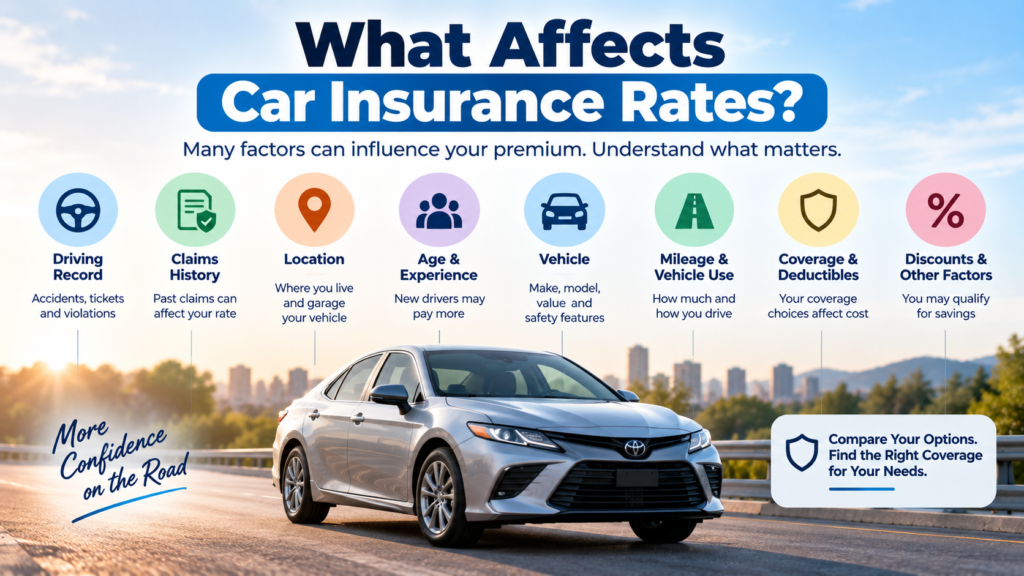
Car insurance rates can vary significantly from one driver to another—even when two people live in the same city or drive similar vehicles.
That is because auto insurers generally consider multiple factors when estimating the likelihood and potential cost of future claims.
Your driving record may matter. Your vehicle may matter. Where the vehicle is kept, how much you drive, the coverage you choose, your deductibles, prior claims, and other factors permitted under state law can also influence the premium.
Different insurers can evaluate these factors differently, which is one reason the same driver may receive different quotes from different companies.
Understanding what affects car insurance rates can help you make sense of your premium and compare policies more effectively.
How Do Insurance Companies Determine Car Insurance Rates?
Auto insurers use underwriting and rating processes to evaluate risk and determine premiums.
In simple terms, an insurer tries to estimate:
- How likely a covered claim may be
- How expensive potential claims may be
- What coverage the policy provides
- How much financial risk the insurer is assuming
The insurer then applies its rating system, subject to applicable state insurance laws and regulatory requirements.
Not every insurance company uses exactly the same formula.
That means two insurers can evaluate the same driver differently and produce different premiums.
1. Your Driving Record
Your driving history is one of the most important factors insurers may consider when pricing auto insurance.
Depending on the insurer, state, and circumstances, your record may include information about:
- At-fault accidents
- Speeding tickets
- Moving violations
- Serious traffic offenses
- Other driving-related incidents
A history associated with more frequent or severe losses can potentially result in a higher premium.
A cleaner driving history may help you qualify for more favorable pricing or certain discounts, depending on the insurer.
How Long Do Accidents and Tickets Affect Insurance Rates?
There is no single nationwide rule determining how long every accident or violation affects a car insurance premium.
The impact can depend on:
- State law
- Type of violation
- Severity of the incident
- Insurer rating rules
- Time since the event
- Other driving-history factors
An old minor violation may be treated differently from a recent serious offense.
If you want to know how a specific incident affects your premium, ask the insurer how it is being considered.
2. Your Claims History
Your insurance claims history can also affect auto insurance pricing.
Insurers may review prior claims when evaluating expected future risk.
Factors can include:
- Number of claims
- Types of claims
- Severity of losses
- Timing of claims
- Responsibility for accidents
- Other circumstances permitted under applicable rules
Not every claim affects every driver in the same way.
For example, an at-fault collision may be evaluated differently from certain comprehensive claims.
State rules may also restrict how particular claims can be used.
Does Filing One Claim Always Increase Your Rate?
No.
A claim does not automatically mean your premium will increase.
The result can depend on:
- Type of claim
- Fault
- Amount paid
- Your prior history
- State regulations
- Insurer rules
- Applicable accident-forgiveness provisions
The safest approach is not to assume either that a claim will increase your premium or that it will have no effect.
Ask your insurer how the claim may influence your policy.
3. Where You Live and Garage Your Vehicle
Location can affect car insurance rates because claim patterns differ by geographic area.
Depending on applicable state rules, insurers may consider factors associated with where your vehicle is principally kept.
These can relate to differences in:
- Accident frequency
- Theft
- Vandalism
- Weather-related losses
- Repair costs
- Medical costs
- Traffic density
- Other local claim patterns
Two drivers with otherwise similar characteristics may therefore pay different premiums if their vehicles are garaged in different locations.
Can Moving Change Your Car Insurance Rate?
Yes.
Moving to another ZIP code, city, or state can potentially change your premium.
The new location may have different:
- Insurance requirements
- Claim frequencies
- Repair costs
- Theft patterns
- Traffic conditions
- Rating territories
A move to another state can create even larger changes because insurance laws and minimum coverage requirements vary by state.
Always provide the insurer with the accurate address where the vehicle is principally garaged as required by the policy.
4. Your Age and Driving Experience
Age and driving experience can influence auto insurance pricing where permitted.
Newer drivers generally have less driving history for insurers to evaluate and may be associated with different expected claim patterns than experienced drivers.
However, age is not the only consideration.
Insurers may also consider the number of years a person has been licensed or driving, depending on their rating practices and applicable law.
State rules can affect how these characteristics are used.
Why Can Insurance Be Expensive for Young Drivers?
Young or newly licensed drivers may face higher premiums because insurers evaluate historical claim patterns associated with drivers who have less experience.
The premium may also depend on:
- Vehicle
- Location
- Coverage
- Driving record
- Household structure
- Available discounts
- Other permitted factors
Some insurers offer discounts or programs for eligible younger drivers, such as certain good-student or driver-training discounts.
Availability varies by insurer and state.
5. Your Vehicle
The car you drive can have a meaningful effect on your insurance premium.
Insurers may consider vehicle-related characteristics associated with expected claim costs.
These can include factors involving:
- Vehicle value
- Repair costs
- Parts prices
- Safety characteristics
- Theft experience
- Claims experience for the model
- Performance characteristics
- Other vehicle information
Two vehicles with similar purchase prices can still have different insurance costs.
An Expensive Car Is Not the Only Vehicle That Can Cost More to Insure
Purchase price is only one consideration.
A less expensive vehicle could potentially have higher insurance costs if it:
- Is costly to repair
- Has expensive replacement parts
- Has unfavorable theft experience
- Has higher historical claim costs
- Has particular performance characteristics
Likewise, a more expensive vehicle might include safety technology or other characteristics that affect its insurance pricing.
For this reason, it can be useful to obtain insurance estimates before purchasing a vehicle.
6. Vehicle Repair Costs
Modern vehicles can contain sophisticated equipment such as:
- Cameras
- Sensors
- Radar systems
- Advanced headlights
- Driver-assistance technology
- Electronic components
A seemingly minor collision can sometimes require expensive parts, calibration, or specialized labor.
Insurers consider expected repair and claim costs when establishing rates.
Therefore, a vehicle’s insurance cost is not determined simply by its age or purchase price.
7. Vehicle Use
How you use your vehicle can affect its insurance pricing.
An insurer may ask whether the vehicle is primarily used for:
- Commuting
- Pleasure
- Business
- School
- Other purposes
A vehicle driven regularly in heavy commuting traffic may present a different exposure than one used occasionally.
Be accurate when describing vehicle use.
Do not classify a vehicle as pleasure-use simply to try to obtain a lower premium if it is actually used differently.
8. Annual Mileage
The amount you drive can influence auto insurance pricing.
In general, more time on the road creates more opportunities for an accident or other claim.
Insurers may therefore ask for estimated annual mileage.
Possible mileage differences could come from:
- Daily commuting
- Remote work
- Long-distance travel
- School travel
- Multiple vehicles in a household
- Changes in employment
If your driving habits have changed substantially, it may be worth updating the insurer with accurate mileage information.
Can Driving Less Lower Your Insurance Rate?
Possibly.
Some insurers offer pricing or discounts that recognize lower mileage.
However, the effect depends on:
- Insurer
- State
- Rating method
- Actual mileage
- Available programs
Reducing annual mileage does not guarantee a particular premium reduction.
Ask the insurer whether mileage affects your current policy.
9. Your Coverage Limits
The amount of insurance protection you select directly affects the insurer’s potential financial responsibility.
Higher liability limits generally provide more potential coverage than lower limits.
For example, a policy with substantially higher bodily injury and property damage liability limits may cost more than one using minimum limits, all else being equal.
But choosing coverage solely to achieve the lowest premium can leave you with less protection.
Evaluate limits based on your circumstances rather than price alone.
10. Comprehensive and Collision Coverage
Adding comprehensive and collision coverage generally increases the premium compared with a similar policy without those coverages.
Collision coverage generally helps with certain covered damage to your own vehicle resulting from a collision.
Comprehensive coverage generally helps with certain covered non-collision losses, such as theft, vandalism, hail, fire, falling objects, or animal-related damage, subject to policy terms.
A policy containing liability, comprehensive, and collision is commonly described informally as “full coverage.”
However, full coverage is not a standardized policy and does not mean every possible loss is insured.
11. Your Deductibles
A deductible is generally the amount you are responsible for toward an applicable covered physical-damage claim before insurance payment.
Common comprehensive or collision deductible options might include:
- $250
- $500
- $1,000
- $1,500
Available options vary.
Generally, increasing your deductible means you are accepting more of the financial risk yourself.
This can lower the premium, all else being equal.
Should You Raise Your Deductible to Lower Your Rate?
A higher deductible can reduce your premium, but it is not automatically the best decision.
Consider whether you could comfortably pay the deductible after an unexpected loss.
For example, if increasing your collision deductible from $500 to $1,500 saves money on premiums but you would struggle to pay $1,500 after an accident, the trade-off may not be suitable.
Compare the premium savings with the additional financial responsibility you are accepting.
12. Previous Insurance Coverage
An insurer may consider certain information about prior insurance coverage where permitted.
Depending on the company and state, this can include whether you maintained continuous prior auto insurance.
A lapse in insurance can sometimes affect future premiums.
It may also create legal or registration problems in situations where coverage is required.
Avoid allowing required coverage to lapse simply to save money temporarily.
Why Can an Insurance Lapse Matter?
A lapse means there was a period during which insurance coverage was not in force.
Depending on circumstances, an insurer may view prior insurance history as part of its risk evaluation.
A lapse can also result from situations such as:
- Failing to pay a premium
- Canceling before replacement coverage starts
- Allowing a policy to expire
- Vehicle-registration issues
If switching insurers, coordinate effective dates so the new policy begins before the old coverage ends.
13. Credit-Based Insurance Information
In states where it is legally permitted, insurers may use credit-related information as one factor in underwriting or rating auto insurance.
This often involves a credit-based insurance score.
A credit-based insurance score is not necessarily the same as the credit score used by a lender when deciding whether to approve a loan.
Insurance scoring is intended to help insurers estimate insurance risk.
However, state laws impose restrictions, and some states prohibit or significantly limit the use of credit information for auto insurance.
Does Bad Credit Always Mean Higher Car Insurance Rates?
No universal answer applies nationwide.
Credit-related insurance information may affect premiums in states where its use is permitted, but:
- State laws differ
- Insurer models differ
- Credit information is only one potential factor
- Other rating factors still matter
- Some states restrict or prohibit its use
If credit-related information affected an insurance decision, applicable laws may provide certain disclosure or consumer rights.
Check with your insurer or state insurance regulator if you need information specific to your location.
14. Driver Characteristics Allowed Under State Law
Depending on state law, insurers may consider certain driver characteristics when pricing auto insurance.
These may include factors such as:
- Age
- Driving experience
- Gender
- Marital status
- Other permitted characteristics
The availability and use of these factors vary because states regulate insurance differently.
Some jurisdictions restrict or prohibit the use of particular factors.
For an educational nationwide guide, it is important not to assume every characteristic is used in every state.
15. Number of Drivers and Vehicles on the Policy
Adding drivers or vehicles can change the premium.
A household policy may be affected by:
- Number of insured vehicles
- Drivers associated with the household
- Driver ages and experience
- Driving histories
- Vehicle assignments
- Coverage selected for each vehicle
Adding another vehicle may increase total premium, although eligible multi-vehicle discounts can sometimes offset part of the additional cost.
Likewise, adding a newly licensed driver can materially affect the policy.
16. Teen Drivers
Adding a teen or newly licensed driver can significantly change household auto insurance costs.
Pricing can depend on:
- Driver age
- Driving experience
- Vehicle assignment
- Location
- Coverage
- Insurer
- Eligible discounts
- State rating rules
Some insurers may offer eligible discounts related to good grades, approved driver education, or other programs.
The specific requirements vary.
17. Insurance Discounts
Discounts can affect the final premium, although availability differs by insurer and state.
Possible discounts may relate to:
- Multiple vehicles
- Multiple policies
- Safe-driving history
- Vehicle safety equipment
- Anti-theft devices
- Good-student eligibility
- Approved driver education
- Automatic payments
- Paperless billing
- Paying premiums in full
- Low mileage
- Telematics programs
Do not assume every advertised discount applies automatically.
Ask which discounts have already been included in your quote and what requirements must be satisfied.
18. Bundling Insurance Policies
Some insurers offer discounts when customers purchase multiple insurance products from the same company.
A common example is combining:
- Auto insurance
- Homeowners insurance
This is often called bundling.
Bundling may reduce the price of one or both policies, but it does not automatically produce the lowest total cost.
Compare the combined premium and coverage against alternatives.
A large percentage discount can sound attractive while another insurer could still offer a lower overall price.
19. Payment Method
How you pay for insurance can sometimes affect your total cost.
Depending on the insurer, options may include:
- Monthly installments
- Semiannual payments
- Annual payments
- Automatic electronic payments
Some insurers offer discounts for paying in full or using automatic payments.
Installment plans may also involve fees.
When comparing quotes, review the total policy cost, not simply the monthly payment.
20. Policy Term
Auto insurers may issue policies for different periods, commonly such as:
- Six months
- Twelve months
Do not compare the headline price of a six-month policy directly with a twelve-month policy.
Always confirm:
- Policy period
- Total premium
- Down payment
- Installment fees
- Renewal timing
This produces a more meaningful comparison.
21. Telematics and Usage-Based Insurance
Some insurers offer telematics or usage-based insurance programs.
Depending on the program and technology, insurers may collect information about driving behavior such as:
- Mileage
- Time of day
- Acceleration
- Braking
- Cornering
- Other driving-related data
The program may use a mobile app, connected vehicle, or another device.
Pricing rules differ significantly among programs.
Can Telematics Lower Your Car Insurance Rate?
It can in some programs, particularly when the insurer’s rating model views the measured driving behavior favorably.
But you should not assume participation always guarantees lower premiums.
Before enrolling, determine:
- What information is collected
- How the information affects pricing
- Whether a discount is guaranteed or conditional
- Whether unfavorable driving behavior can affect pricing
- How long monitoring lasts
- What privacy terms apply
- Whether participation is optional
Read the actual program rules before enrolling.
22. Claims Costs in Your Area
Your premium can change even when you personally have not caused an accident.
Insurance rates reflect expected claim costs across groups of insured drivers.
If insurers experience increasing costs involving:
- Vehicle repairs
- Replacement parts
- Medical expenses
- Theft
- Severe weather
- Litigation
- Other insured losses
rates may be adjusted subject to applicable regulatory rules.
This means a premium increase does not always indicate that you personally did something wrong.
Why Can My Rate Increase Even With a Clean Driving Record?
A clean record is valuable, but it is only one part of auto insurance pricing.
Your premium can potentially change because of factors such as:
- Changes in insurer rates
- Higher repair costs
- Changes in local claim patterns
- Vehicle-related factors
- Changes in available discounts
- Coverage changes
- Location changes
- Regulatory or market changes
- Other permitted rating factors
If your premium increases unexpectedly, ask your insurer for an explanation and review whether anything on the policy changed.
23. Inflation and Repair Expenses
The cost of settling auto claims can be affected by broader economic conditions.
For example, increases in:
- Replacement parts
- Labor
- Vehicle values
- Rental vehicles
- Medical treatment
can contribute to higher claim costs.
If insurers expect future claims to cost more, that can influence overall insurance pricing, subject to regulatory oversight.
Individual premium changes can still differ from broader market trends.
24. Vehicle Theft and Vandalism Risk
Theft and vandalism experience can influence comprehensive insurance costs.
Insurers may consider claims patterns associated with:
- Particular vehicle models
- Locations
- Anti-theft systems
- Other risk information
Some vehicles may be more frequently targeted for theft or may have costly theft-related claims.
Eligible anti-theft equipment can sometimes qualify for discounts, depending on the insurer.
25. Safety Features
Vehicle safety features can influence insurance pricing in complex ways.
Possible features include:
- Airbags
- Automatic emergency braking
- Lane-assistance technology
- Collision-warning systems
- Anti-theft systems
Some equipment may reduce certain risks or qualify for discounts.
At the same time, advanced technology can sometimes increase repair costs after a collision.
For example, sensors or cameras may require replacement or recalibration.
Therefore, more safety technology does not automatically guarantee a cheaper premium.
26. Where the Vehicle Is Parked
Your garaging situation may be relevant depending on the insurer’s rating system and state rules.
A vehicle that is principally kept in one location can have different expected loss patterns from a vehicle kept elsewhere.
Use the true primary garaging address when requesting insurance.
Misrepresenting where a vehicle is kept to obtain a lower premium can create serious problems with underwriting or claims.
27. Changes at Renewal
Your premium is not necessarily fixed forever.
When a policy renews, pricing can change because of:
- Updated insurer rates
- Recent accidents or violations
- Claims
- Discount changes
- Vehicle changes
- Mileage changes
- Location changes
- Coverage changes
- Other permitted rating information
Review renewal documents instead of assuming the new policy is identical to the old one.
Which Factors Can You Control?
Not every rating factor is within your control.
You generally cannot immediately change things such as historical claims patterns in your area.
However, there are several areas you may be able to review.
Driving Behavior
Maintaining safer driving habits can help reduce the risk of tickets and accidents.
Coverage Selections
You can review your liability limits, optional coverages, and physical-damage coverage.
Do not reduce important protection only to lower the premium.
Deductibles
You may be able to increase comprehensive or collision deductibles if you can comfortably assume more of the loss yourself.
Mileage
If you genuinely drive fewer miles than before, provide accurate updated information to your insurer.
Discounts
Ask whether you qualify for discounts that are not currently applied.
Shopping Around
Different insurers evaluate risk differently, so comparing similar quotes can sometimes reveal meaningful price differences.
Which Factors Are Harder to Control?
Some factors are not easily changed for insurance purposes.
Examples may include:
- Driver age
- Past accidents
- Previous claims
- Local claim environment
- Certain vehicle characteristics
- Market-wide claim costs
This is one reason it is often more productive to compare available insurers and coverage structures than to search for a single trick that will dramatically reduce your premium.
How to Lower Car Insurance Costs Without Sacrificing Important Coverage
If your premium feels high, consider a structured review.
Compare Multiple Quotes
Use similar drivers, vehicles, liability limits, deductibles, and optional coverage when comparing insurers.
Review Discounts
Ask the insurer to explain every discount currently applied and whether other legitimate discounts are available.
Review Deductibles
Consider whether a higher physical-damage deductible offers worthwhile premium savings without creating an unaffordable out-of-pocket obligation.
Review Optional Coverage
Determine whether optional coverages still match your needs.
Review Older Vehicles
For vehicles owned outright, consider whether comprehensive and collision costs remain reasonable relative to vehicle value and your ability to replace the vehicle.
Consider Bundling
Compare the total price of bundled policies with separately purchased alternatives.
Maintain Accurate Policy Information
Make sure mileage, vehicle use, drivers, garaging address, and other information are correct.
Don’t Reduce Liability Limits Without Understanding the Risk
When trying to lower insurance costs, reducing liability limits can appear attractive.
But lower limits also reduce the amount of liability protection available after a covered accident.
Before changing limits, consider:
- Assets
- Income
- Potential financial exposure
- State requirements
- Available coverage options
If you need individualized advice about appropriate limits, consider discussing your situation with a licensed insurance professional.
Why Comparing Quotes Can Matter
Because insurers use their own rating systems, the same driver can receive different premiums for similar coverage.
One insurer may price your combination of:
- Vehicle
- Location
- Driving history
- Mileage
- Coverage
- Other permitted factors
more favorably than another.
That does not necessarily mean the least expensive insurer is always the best choice.
Compare:
- Coverage limits
- Deductibles
- Optional coverage
- Discounts
- Total premium
- Insurer service
- Financial information
- Policy terms
An apples-to-apples comparison is more useful than simply choosing the smallest quoted monthly payment.
Before comparing prices, review our auto insurance guide to better understand common coverage types, limits, and deductibles.
Questions to Ask If Your Car Insurance Rate Increased
If you receive a higher renewal premium, consider asking:
- Did the insurer change its rates?
- Did my coverage change?
- Did my deductibles change?
- Did any discount expire?
- Did an accident, violation, or claim affect the premium?
- Did my mileage classification change?
- Did my address or garaging information change?
- Were drivers added or changed?
- Did my vehicle classification change?
- Are there legitimate discounts I may now qualify for?
- What would the premium be with different deductible options?
Understanding the reason for the change can help you decide what to do next.
Common Mistakes When Trying to Lower Car Insurance Rates
Choosing the Cheapest Quote Without Comparing Coverage
A lower premium may result from lower limits or higher deductibles.
Providing Incorrect Mileage
Always provide accurate information.
Using the Wrong Garaging Address
Your insurer should receive the actual required location information.
Removing Coverage Without Checking Loan Requirements
Financed or leased vehicles may be required to maintain comprehensive and collision coverage.
Raising the Deductible Too High
Premium savings may not be worthwhile if you cannot afford the deductible after a claim.
Ignoring Discounts
Ask whether all eligible discounts are being applied.
Letting Coverage Lapse
A lapse can create insurance, legal, or financial complications.
Assuming Loyalty Guarantees the Best Price
Your current insurer may remain competitive, but comparing equivalent quotes can provide useful information.
Frequently Asked Questions
What has the biggest effect on car insurance rates?
There is no universal single factor for every driver. Insurers commonly consider multiple factors such as driving record, claims history, location, vehicle, mileage, coverage selections, deductibles, and other characteristics permitted under state law.
Does an accident increase car insurance rates?
It can, but the effect depends on factors such as fault, claim severity, driving history, insurer rules, state regulations, and any applicable accident-forgiveness provisions.
Do speeding tickets affect car insurance?
They can. Insurers may consider driving violations when evaluating risk. The effect varies depending on the violation, insurer, state, and driving history.
Does the car you drive affect your rate?
Yes. Insurers may consider vehicle value, repair costs, theft experience, safety characteristics, historical claim costs, and other vehicle-related information.
Does mileage affect car insurance?
It can. Mileage is a rating factor used by some insurers, and certain companies offer lower-mileage or usage-based programs.
Does where you live affect your car insurance rate?
Yes, location can affect premiums because claim frequency, theft, repair costs, weather risks, and other loss patterns vary geographically. State law determines how rating territories and related information may be used.
Does credit affect car insurance?
In states where permitted, insurers may use credit-based insurance information as one rating or underwriting factor. Restrictions vary by state, and some jurisdictions prohibit or significantly restrict its use.
Does getting married lower car insurance?
Marital status may be used as a rating characteristic in some jurisdictions and by some insurers, but state rules and rating methods vary. Marriage does not guarantee a particular premium reduction.
Can a safer car lower my insurance?
Potentially, but vehicle insurance pricing is complex. Safety features may reduce certain risks or qualify for discounts, while advanced equipment can also make repairs more expensive.
Will raising my deductible lower my premium?
Generally, accepting a higher comprehensive or collision deductible can lower the associated premium, all else being equal. However, you will assume more out-of-pocket responsibility after an applicable claim.
Why did my insurance increase when I had no accidents?
Premiums can change because of insurer rate changes, claims costs, repair costs, local loss patterns, discount changes, vehicle factors, and other permitted rating considerations even if your personal driving record remains clean.
Can switching insurance companies lower my rate?
Possibly. Insurers use different rating systems, so another company may offer a lower premium for comparable coverage. Compare policies carefully rather than price alone.
How often should I compare car insurance?
There is no required schedule. It can be useful to review your options around renewal or after significant changes such as moving, purchasing a vehicle, changing drivers, or experiencing a substantial premium increase.
The Bottom Line
Car insurance rates are based on many factors rather than one simple formula.
Depending on the insurer and applicable state law, important factors may include:
- Driving record
- Claims history
- Location
- Age or driving experience
- Vehicle
- Vehicle use
- Annual mileage
- Liability limits
- Comprehensive and collision coverage
- Deductibles
- Prior insurance
- Credit-related insurance information where permitted
- Discounts
- Telematics participation
- Other permitted rating factors
Some of these factors are within your control, while others are not.
Instead of focusing on a single rating factor, review your policy as a whole.
Make sure your information is accurate, understand the coverage you are purchasing, check available discounts, choose deductibles you could realistically afford, and compare equivalent quotes when appropriate.
Most importantly, remember that a lower premium is not automatically a better insurance policy.
The goal is to find a reasonable balance between price, coverage, deductibles, and the amount of financial risk you are comfortable retaining.