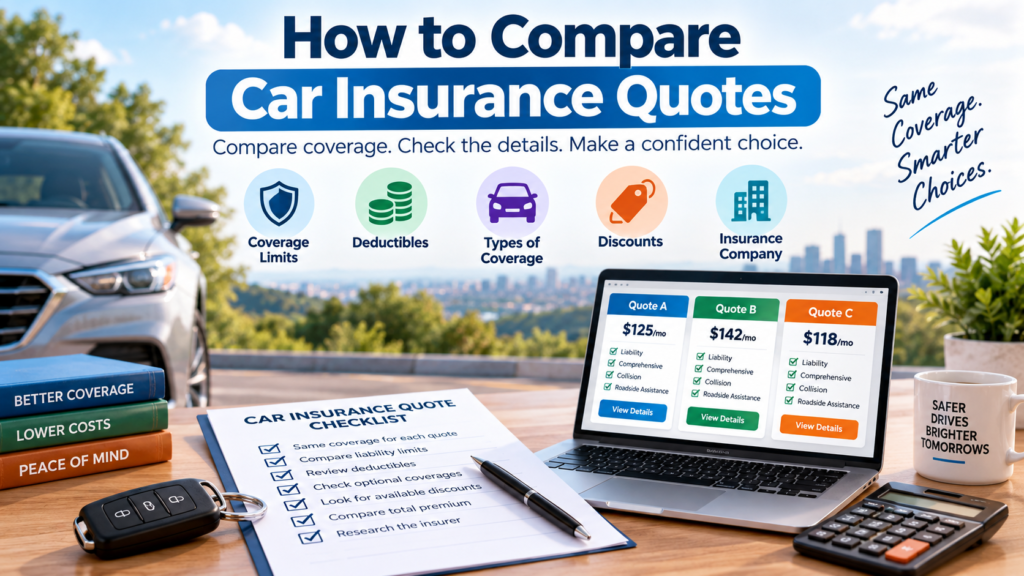
Comparing car insurance quotes can help you understand how different insurers price similar coverage and which policy may offer a suitable combination of protection, price, and service.
But comparing quotes correctly involves more than choosing the lowest number on the screen.
Two car insurance quotes can have very different premiums because they include different liability limits, deductibles, optional coverages, discounts, or policy features. A cheaper quote may provide less protection, while a more expensive quote may include coverage you do not need.
The most useful comparison is an apples-to-apples comparison: request similar coverage from multiple insurers, review the details carefully, and then evaluate price along with coverage, deductibles, exclusions, discounts, and insurer information.
This guide explains how to compare car insurance quotes in the United States and what to check before choosing a policy.
What Is a Car Insurance Quote?
A car insurance quote is an estimate of what an insurer may charge you for a particular auto insurance policy based on the information available when the quote is prepared.
The insurer may consider information such as:
- Your location
- Age and other driver characteristics
- Driving history
- Vehicle
- Coverage selections
- Policy limits
- Deductibles
- Annual mileage or vehicle use
- Other rating factors permitted in your state
A quote is not necessarily the final premium.
The amount can change if the insurer verifies additional information, discovers inaccurate or incomplete information, or applies underwriting and rating information that was not available during the initial quote.
For this reason, provide accurate and consistent information when requesting quotes.
Why Compare Car Insurance Quotes?
Auto insurance premiums can vary among insurers even when drivers request similar coverage.
Insurance companies use their own rating models, underwriting guidelines, discounts, and other permitted factors when determining premiums.
As a result, the same driver and vehicle may receive different prices from different insurers.
You can also review our auto insurance guide to understand common coverage options before comparing quotes.
Comparing multiple quotes can help you evaluate:
- Premium differences
- Coverage options
- Liability limits
- Deductibles
- Available discounts
- Optional protections
- Payment options
- Policy features
- Insurer service and financial information
The goal should not simply be finding the cheapest quote.
The goal is to understand what you are buying for the quoted price.
Start With the Same Coverage for Every Quote
One of the biggest mistakes consumers make is comparing quotes with different coverage.
Suppose Insurer A quotes $1,400 per year and Insurer B quotes $1,700.
At first glance, Insurer A appears cheaper.
But what if Insurer A includes:
- Lower liability limits
- A $1,500 collision deductible
- No comprehensive coverage
- No rental reimbursement
while Insurer B includes:
- Higher liability limits
- A $500 collision deductible
- Comprehensive coverage
- Rental reimbursement
These are not equivalent policies.
Before comparing prices, try to make the coverage selections as similar as reasonably possible.
Understand Your State’s Minimum Requirements
Auto insurance requirements vary by state.
Depending on the state, drivers may be required to carry certain types or amounts of coverage.
Requirements can involve coverage such as:
- Bodily injury liability
- Property damage liability
- Personal injury protection
- Medical payments
- Uninsured motorist coverage
- Underinsured motorist coverage
The exact requirements and exceptions vary.
State minimum coverage represents a legal requirement in applicable circumstances; it does not necessarily represent the amount of protection that will be appropriate for every driver.
Before purchasing coverage, verify current requirements with your state’s insurance regulator, motor vehicle authority, insurer, or licensed insurance professional.
What Is Liability Insurance?
Liability insurance is one of the most important parts of an auto policy.
It generally helps address covered costs when you are legally responsible for injuries or property damage resulting from an auto accident, subject to the policy terms and limits.
Auto liability coverage commonly includes two components.
Bodily Injury Liability
Bodily injury liability can help cover covered losses involving injuries to other people when you are legally responsible for an accident.
Depending on the claim and policy, covered costs may involve items such as medical expenses, lost income, or legal defense expenses.
Property Damage Liability
Property damage liability can help cover covered damage you cause to someone else’s property.
This commonly includes another person’s vehicle but can also involve other covered property.
Compare the Same Liability Limits
When comparing quotes, check the liability limits carefully.
A policy may display limits in a format such as:
100/300/100
In a typical split-limit format, this may represent:
- $100,000 bodily injury liability limit per person
- $300,000 bodily injury liability limit per accident
- $100,000 property damage liability limit per accident
The exact interpretation should be confirmed from the policy or quote.
If one insurer quotes minimum liability limits and another quotes substantially higher limits, comparing only the premiums can be misleading.
Try to request the same liability limits from each insurer.
State Minimum Liability Limits May Not Be Enough for Everyone
Purchasing only the minimum coverage required by your state may reduce the premium, but it can also leave you with lower liability protection.
If a covered accident produces losses greater than your applicable policy limit, the policy generally will not simply increase its limit because the claim is expensive.
Your financial exposure will depend on the circumstances, applicable law, policy terms, and available coverage.
When choosing liability limits, consider your financial circumstances and potential exposure rather than automatically selecting the lowest legal limit.
A licensed insurance professional can help explain available limits when you need individualized guidance.
What Is Collision Coverage?
Collision coverage generally helps pay for covered damage to your vehicle resulting from a collision with another vehicle or object, subject to your deductible and policy terms.
Examples may include covered damage from:
- Colliding with another vehicle
- Hitting a guardrail
- Hitting a pole
- Certain rollover accidents
Collision coverage is generally optional under state insurance laws, although a lender or leasing company may require it when a vehicle is financed or leased.
What Is Comprehensive Coverage?
Comprehensive coverage generally addresses certain covered physical damage to your vehicle that is not caused by a collision.
Depending on the policy, examples may include:
- Theft
- Vandalism
- Fire
- Hail
- Falling objects
- Certain weather events
- Animal-related damage
- Broken glass under applicable policy provisions
Like collision coverage, comprehensive coverage commonly has a deductible.
When comparing quotes, check whether both comprehensive and collision are included and whether the deductibles are the same.
Compare Deductibles Carefully
A deductible is generally the amount you are responsible for paying toward a covered physical-damage claim before the applicable insurance payment.
Common deductible choices might include amounts such as:
- $250
- $500
- $1,000
- $1,500
Available choices vary by insurer.
Increasing a deductible may reduce the premium because you agree to assume more of the initial cost of a covered loss.
But a higher deductible also means you may need to pay more yourself if a covered claim occurs.
For a fair comparison, make sure the quotes use similar comprehensive and collision deductibles.
Do Not Choose a Deductible You Cannot Comfortably Pay
A high deductible can make a premium look attractive.
However, consider what would happen if your vehicle were damaged tomorrow.
If your collision deductible is $1,500, could you reasonably handle that amount as part of a covered repair claim?
The lowest premium is not necessarily useful if the deductible creates a financial burden you would struggle to meet.
Choose a deductible by considering both premium savings and your ability to absorb the deductible after an unexpected loss.
What Is Uninsured Motorist Coverage?
Uninsured motorist coverage can provide protection under applicable circumstances when you are involved in a covered accident with a driver who does not have applicable liability insurance.
Coverage structures and requirements vary significantly by state.
Depending on the state and policy, uninsured motorist protection may involve bodily injury and, in some places or policies, property damage.
Do not assume this coverage works identically everywhere.
What Is Underinsured Motorist Coverage?
Underinsured motorist coverage can apply in certain covered circumstances when an at-fault driver has insurance but does not have enough applicable liability coverage to fully address covered losses.
As with uninsured motorist coverage, requirements, availability, limits, and policy provisions vary by state.
When comparing quotes, check whether uninsured and underinsured motorist coverage is:
- Included
- Optional
- Rejected where legally permitted
- Offered at different limits
A lower quote may sometimes reflect a difference in these selections.
What About Personal Injury Protection and Medical Payments?
Depending on your state and policy, you may encounter Personal Injury Protection (PIP) or Medical Payments coverage (MedPay).
PIP can help cover certain medical expenses and other specified losses following a covered auto accident, depending on state law and policy terms.
Medical Payments coverage can generally help pay certain medical expenses for you and eligible passengers following a covered accident, subject to policy provisions and limits.
These coverages are not identical.
Their availability, requirements, and operation vary by state.
Make sure competing quotes handle these coverages consistently before comparing premiums.
What Does “Full Coverage” Mean?
Consumers frequently use the phrase full coverage, but it is not a standardized policy that guarantees protection against every possible loss.
People often use the term to describe an auto policy containing:
- Liability coverage
- Collision coverage
- Comprehensive coverage
The policy may also include other required or optional coverages.
However, even a policy described informally as “full coverage” has limits, deductibles, exclusions, and conditions.
Instead of asking only for “full coverage,” specify the actual coverages, limits, and deductibles you want quoted.
Information to Gather Before Requesting Quotes
Having accurate information ready can make the quote process easier and improve the quality of your comparisons.
You may need information about the following.
Drivers
Prepare details for household members or other drivers as required by the insurer, such as:
- Name
- Date of birth
- Driver’s license information
- Driving history
- Accident history
- Traffic violations
- Other requested underwriting information
Vehicles
You may need:
- Year
- Make
- Model
- Vehicle identification number (VIN)
- Ownership or financing information
- Estimated annual mileage
- Primary use of the vehicle
- Garaging location
- Safety or anti-theft features
Current Insurance
If you already have auto insurance, your current declarations page can be particularly useful.
It may show:
- Existing coverages
- Liability limits
- Deductibles
- Vehicles
- Drivers
- Optional endorsements
Using your current policy as a reference can make apples-to-apples quoting easier.
Use the Same Driver Information for Every Quote
Small differences in the information submitted can affect quote results.
For example, one quote should not use 6,000 estimated annual miles while another uses 15,000 unless that difference is intentional and accurate.
Likewise, be consistent about:
- Vehicle use
- Drivers
- Address
- Coverage limits
- Deductibles
- Accident information
- Driving history
Do not intentionally omit relevant drivers, accidents, violations, or other requested information to obtain a lower quote.
An inaccurate quote may change when the insurer verifies the application.
Compare Policy Terms, Not Just Monthly Payments
Some insurance quotes emphasize a monthly payment.
That can be convenient for budgeting, but it may not show the complete cost.
Check:
- Total policy premium
- Length of the policy term
- Down payment
- Installment fees
- Automatic-payment requirements
- Paid-in-full discounts
- Other billing charges
For example, a monthly payment multiplied by six may not always equal the exact six-month policy cost if the first payment, installment fees, or billing structure differs.
Compare the total premium for equivalent policy periods whenever possible.
Six-Month vs. Twelve-Month Policies
Auto insurers may offer policy terms of different lengths.
Common examples include six-month and twelve-month policies.
When comparing quotes, confirm that you are comparing the same time period.
A $900 six-month premium should not be compared directly with a $1,500 twelve-month premium as though both cover the same duration.
Look at the policy period and total premium.
Review Every Discount
Insurers may offer discounts based on eligibility.
Possible examples can include discounts related to:
- Multiple policies
- Multiple vehicles
- Safe driving
- Certain vehicle safety features
- Anti-theft equipment
- Automatic payments
- Paying the premium in full
- Paperless billing
- Student eligibility
- Driver education
- Low mileage
- Telematics or usage-based insurance
Availability and eligibility vary by insurer and state.
Ask which discounts are already included in your quote and which require additional action.
Bundling Home and Auto Insurance
Some insurers offer discounts when customers purchase more than one type of insurance from the same company, such as auto and homeowners insurance.
This is often called bundling.
A bundle discount can reduce premiums, but do not assume bundling automatically produces the lowest total cost.
Compare the combined cost and coverage of bundled policies with reasonable alternatives.
A large advertised percentage discount does not necessarily mean the final premium will be lower than every competitor.
Understand Telematics Before Enrolling
Usage-based or telematics insurance programs may use driving-related information to determine eligibility for discounts or influence pricing according to program terms and applicable law.
Depending on the program, information could involve factors such as:
- Mileage
- Time of day
- Braking
- Acceleration
- Speed-related information
- Phone interaction or other driving behavior
Programs vary substantially.
Before enrolling, understand:
- What information is collected
- How it is used
- How long the monitoring period lasts
- Whether participation can affect premiums
- Whether participation is optional
- Applicable privacy terms
Do not enroll solely because an initial discount is advertised without understanding the program.
Check Optional Coverages
Two otherwise similar quotes may differ because one includes optional coverages that the other does not.
Examples may include:
Rental Reimbursement
Can help with eligible rental transportation expenses while your covered vehicle is being repaired after a qualifying covered loss, subject to limits and policy terms.
Roadside Assistance
May provide specified services such as towing, battery assistance, lockout service, or tire-related assistance under the policy or program.
Gap Coverage
Depending on the product and circumstances, gap-related coverage can help address certain differences between an eligible vehicle’s covered value and an outstanding loan or lease balance after a covered total loss.
Coverage varies considerably, and gap products may also be available from lenders or other providers.
New Car Replacement
Some insurers offer optional coverage that may provide enhanced replacement provisions for qualifying newer vehicles after certain total losses.
Eligibility and terms vary.
Accident Forgiveness
Some insurers offer programs under which an eligible accident may be treated differently for certain rating purposes.
The exact benefit, eligibility, cost, and limitations vary.
Do not assume optional coverages with similar names work identically across insurers.
Consider Whether You Need Comprehensive and Collision on an Older Vehicle
As a vehicle gets older and its value declines, some owners reconsider whether to maintain comprehensive and collision coverage.
There is no universal vehicle age at which these coverages should automatically be removed.
Consider factors such as:
- Vehicle value
- Comprehensive and collision premiums
- Deductibles
- Ability to replace or repair the vehicle yourself
- Loan or lease requirements
- Your tolerance for financial risk
If a lender or leasing company requires physical-damage coverage, you may not have the option to remove it while the requirement applies.
Check the Insurer, Not Just the Price
Price is important, but an insurance policy is also a promise to handle covered claims according to its terms.
Before choosing an insurer, consider researching:
- Licensing in your state
- Complaint information
- Customer service
- Claims service
- Financial strength information
- Available service channels
Your state’s insurance department can be a useful resource for licensing and consumer information.
Financial-strength ratings can provide additional information, although they should not be treated as the only factor when selecting an insurer.
Look at Complaint Information Carefully
Insurance regulators may publish complaint information about insurers.
Complaint data can provide useful context, but raw complaint numbers alone can be misleading because large insurers may naturally receive more complaints simply because they insure more customers.
When available, consider complaint information relative to the insurer’s size or market share and understand what the regulator’s metric represents.
Use complaint information as one factor rather than the sole basis for a decision.
Review the Quote Line by Line
Before accepting a quote, compare the details side by side.
Check:
- Drivers listed
- Vehicles listed
- Garaging address
- Vehicle use
- Liability limits
- Uninsured/underinsured motorist limits
- PIP or MedPay, if applicable
- Comprehensive coverage
- Collision coverage
- Deductibles
- Rental reimbursement
- Roadside assistance
- Other optional coverage
- Discounts
- Policy term
- Total premium
- Payment fees
A simple side-by-side comparison can reveal why one quote costs less.
Example of an Apples-to-Apples Quote Comparison
Suppose you obtain three hypothetical quotes.
For each insurer, you request:
- The same drivers
- The same vehicle
- The same liability limits
- The same uninsured/underinsured motorist selections
- $500 comprehensive deductible
- $500 collision deductible
- The same optional coverages
- The same policy period
Now the premium differences become more meaningful because the coverage structures are reasonably similar.
If one quote is still substantially cheaper, investigate why.
It may reflect:
- Different rating models
- Different discounts
- Different underwriting
- Different optional features
- Other permitted rating factors
This is much more useful than comparing three quotes with unrelated coverage selections.
Why Car Insurance Quotes Can Be Different
Insurance companies do not all calculate premiums in exactly the same way.
Depending on state law and insurer practices, pricing may consider factors such as:
- Location
- Driving record
- Claims history
- Age or driving experience
- Vehicle type
- Vehicle usage
- Annual mileage
- Coverage limits
- Deductibles
- Prior insurance information
- Other permitted rating characteristics
Some states restrict or prohibit the use of particular rating factors.
This is one reason car insurance pricing can vary substantially by state and insurer.
Does Your Credit Affect Car Insurance Quotes?
In states where permitted, insurers may use a credit-based insurance score or related information as one factor in insurance rating or underwriting.
This is not necessarily the same as the credit score a lender uses to approve a loan.
State rules differ significantly.
Some jurisdictions prohibit or restrict the use of credit information for auto insurance.
If you want to understand whether and how credit-related information can affect your insurance, check the rules in your state and ask the insurer.
How Driving History Can Affect Quotes
Driving history is commonly important in auto insurance pricing.
Depending on the insurer, state, and circumstances, factors may include:
- At-fault accidents
- Traffic violations
- Serious driving offenses
- Claims
- Length of driving experience
Different insurers may evaluate the same history differently within applicable state rules.
This is another reason comparing quotes can be useful.
Provide accurate driving-history information because insurers may verify it before finalizing coverage.
How Your Vehicle Can Affect the Quote
The vehicle you insure can affect the premium.
Insurers may consider factors related to:
- Repair costs
- Vehicle value
- Safety characteristics
- Theft experience
- Claims experience for the model
- Engine or performance characteristics
- Other vehicle-related rating information
A vehicle that is inexpensive to purchase is not necessarily inexpensive to insure.
If insurance cost is important to your budget, obtaining insurance estimates before purchasing a vehicle can be useful.
Location Can Affect Car Insurance Costs
Insurance pricing can vary by location.
Depending on applicable rating rules, insurers may consider geographic claims patterns and other location-related risk information.
Moving even within the same state can sometimes affect your premium.
When requesting a quote, use the accurate address where the vehicle is principally garaged as required by the insurer.
Do not use another address simply to try to obtain a lower rate.
Compare Quotes After Major Life Changes
It can be useful to review auto insurance periodically and after significant changes.
Examples include:
- Moving
- Buying another vehicle
- Adding or removing a driver
- Marriage
- A young driver joining the household
- Significant mileage changes
- Paying off a vehicle
- Changes in driving habits
Your existing insurer may remain competitive, but comparing available options can help you understand the current market for your circumstances.
Do Not Cancel Your Existing Policy Too Early
If you decide to switch insurers, coordinate the effective dates carefully.
Ideally, the new policy should be confirmed and effective before the old coverage ends.
A gap in auto insurance coverage can create legal, financial, registration, lender, or future insurance complications depending on your circumstances and state.
Do not cancel an existing policy based solely on an initial quote.
Confirm that the replacement policy has been issued or otherwise properly placed in force for the intended effective date.
Check Cancellation and Refund Rules
If you switch insurance companies before your existing policy expires, ask how cancellation will be handled.
Depending on the insurer, state, payment arrangement, and policy:
- You may receive a refund for certain unused premium
- Cancellation fees or other provisions may apply
- Automatic payments may need to be stopped appropriately
Review your existing insurer’s cancellation procedure before making changes.
Avoid Letting Coverage Lapse
A lapse means there is a period when required or intended insurance coverage is not in force.
In addition to leaving you financially exposed, a lapse can create other consequences.
Depending on state law and circumstances, these might involve:
- Registration issues
- Penalties
- Lender problems
- Higher future insurance costs
- Difficulty obtaining certain coverage
Maintain continuous coverage when required and appropriate.
Be Careful With Extremely Cheap Quotes
An unusually low quote deserves closer inspection.
It does not automatically mean something is wrong, but check whether the quote contains:
- Lower liability limits
- Higher deductibles
- Missing physical-damage coverage
- Missing optional coverage
- Different drivers
- Different vehicle usage
- A discount for which you may not qualify
- A different policy period
The cheapest quote is valuable only if you understand what it actually provides.
Common Mistakes When Comparing Car Insurance Quotes
Comparing Different Liability Limits
A quote with lower limits may naturally cost less.
Comparing Different Deductibles
A $1,500 deductible policy should not be treated as identical to a $500 deductible policy.
Looking Only at the Monthly Payment
Compare the total premium and policy term.
Ignoring Optional Coverages
Rental reimbursement, roadside assistance, and other additions can change the price.
Providing Inconsistent Information
Different mileage, drivers, vehicle use, or accident information can make quotes difficult to compare.
Choosing State Minimum Coverage Automatically
The legal minimum may not provide the amount of protection appropriate for your circumstances.
Ignoring the Insurer
Price should not be the only consideration.
Canceling Existing Insurance Before New Coverage Is Effective
This can create an unintended coverage gap.
A Step-by-Step Car Insurance Quote Checklist
When you are ready to compare quotes, use this process.
Step 1: Review Your Current Policy
Find your declarations page and identify your existing coverage, limits, and deductibles.
Step 2: Decide What Coverage You Want to Compare
Choose consistent liability limits, deductibles, and optional coverages.
Step 3: Gather Accurate Driver and Vehicle Information
Have the information insurers are likely to request available.
Step 4: Request Multiple Quotes
Compare more than one insurer or insurance option when practical.
Step 5: Keep the Inputs Consistent
Use the same drivers, vehicles, limits, deductibles, and major coverage selections.
Step 6: Compare Total Premiums
Make sure the policy periods are equivalent.
Step 7: Review Discounts
Verify which discounts are included and what conditions apply.
Step 8: Research the Insurer
Consider licensing, complaint information, service, and financial-strength information.
Step 9: Read the Policy Details
Understand important limitations, exclusions, and optional coverages before purchasing.
Step 10: Coordinate the Effective Date
If switching insurers, avoid an unintended lapse in coverage.
Questions to Ask Before Choosing a Quote
Before purchasing, consider asking:
- Are all household or applicable drivers correctly listed?
- Are all vehicles correctly listed?
- What liability limits does this quote include?
- What are the comprehensive and collision deductibles?
- Does the policy include uninsured and underinsured motorist coverage?
- Does PIP or MedPay apply?
- What optional coverages are included?
- Which discounts have been applied?
- Could any quoted discount later be removed?
- What is the total premium for the full policy term?
- Are installment or billing fees charged?
- How are claims reported?
- What happens if I add a driver or vehicle?
- What happens at renewal?
- What cancellation rules apply?
The answers can help you identify differences that are not obvious from the headline premium.
How Often Should You Compare Car Insurance Quotes?
There is no rule requiring you to shop for insurance at a particular interval.
However, reviewing your policy periodically can be useful, especially when:
- Your policy is approaching renewal
- Your premium changes significantly
- You move
- You buy or replace a vehicle
- Your household drivers change
- Your driving habits change
- You want different coverage limits or deductibles
Do not switch automatically every time you find a slightly lower price.
Consider coverage, service, discounts, policy features, and any consequences of changing insurers.
Is the Cheapest Car Insurance Quote the Best?
Not necessarily.
The lowest-priced quote may be appropriate in some circumstances, but price alone does not tell you:
- How much liability protection you have
- What deductibles apply
- Which losses are covered
- Which optional protections are included
- What exclusions or limitations apply
- How the insurer handles service and claims
A better comparison asks:
What coverage am I receiving for this premium?
That question encourages you to compare value rather than simply selecting the smallest number.
Frequently Asked Questions
How many car insurance quotes should I compare?
There is no required number. Comparing multiple quotes can provide a better view of available pricing and coverage. The important part is using reasonably consistent information and coverage selections.
Are online car insurance quotes accurate?
Online quotes can provide useful estimates, but the final premium may change when the insurer verifies driving history, vehicle information, eligibility, discounts, or other underwriting and rating information.
Does getting a car insurance quote hurt my credit score?
The effect, if any, depends on how the insurer obtains and uses credit-related information and applicable state rules. Insurance-related credit inquiries are not necessarily treated like applications for consumer loans. If this matters to you, ask the insurer how its quote process handles credit information.
Why is one car insurance quote much cheaper than another?
Possible reasons include different rating models, discounts, coverage limits, deductibles, optional coverages, underwriting practices, or differences in the information used for the quote.
Should I choose the highest deductible to lower my premium?
Not automatically. A higher deductible can reduce premiums but increases the amount you may need to pay after a covered loss. Choose an amount you could reasonably handle.
Is minimum car insurance enough?
State minimum coverage satisfies applicable legal requirements in certain circumstances but may not provide enough protection for every driver. Appropriate limits depend on your circumstances and potential financial exposure.
Do I need comprehensive and collision coverage?
State law generally does not require these coverages in the same way liability insurance may be required, but lenders and leasing companies often require physical-damage coverage. Whether maintaining it otherwise makes sense depends on factors including vehicle value, cost, deductible, and your financial circumstances.
What information do I need for a car insurance quote?
Insurers commonly request information about drivers, vehicles, address, driving history, vehicle usage, mileage, desired coverage, and current insurance. Exact requirements vary.
Can I switch car insurance companies before my policy expires?
Generally, policyholders can change insurers, but cancellation procedures, refunds, fees, and state-specific rules can apply. Make sure replacement coverage is effective before ending the existing policy.
Should I compare quotes at every renewal?
You do not have to, but periodically reviewing available options can help you determine whether your current coverage and price remain suitable.
The Bottom Line
Comparing car insurance quotes is most useful when you compare similar coverage rather than prices alone.
Start by deciding which liability limits, deductibles, physical-damage coverages, and optional protections you want. Then use those selections consistently when requesting quotes from different insurers.
Pay attention to:
- Liability limits
- Comprehensive and collision coverage
- Deductibles
- Uninsured and underinsured motorist coverage
- PIP or Medical Payments coverage where applicable
- Optional protections
- Discounts
- Total policy premium
- Policy period
- Insurer information
A low premium can be attractive, but it should not distract you from meaningful differences in coverage.
Before purchasing a policy, review the quote and policy information carefully, verify that the information about you and your vehicle is accurate, and make sure you understand the coverage you are selecting.
Comparing car insurance quotes on an apples-to-apples basis can help you make a more informed decision about both price and protection.