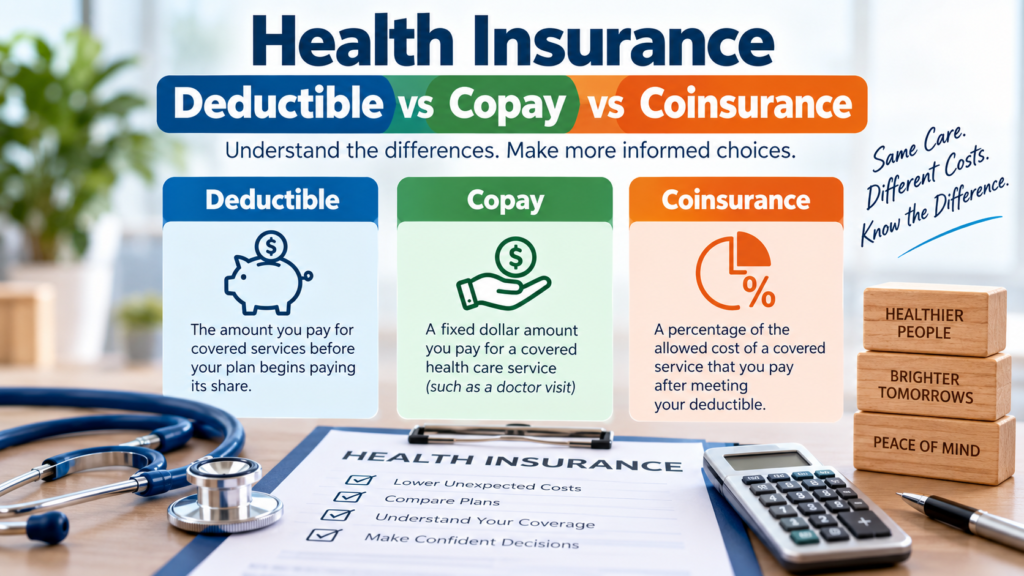
Health insurance comes with several different types of costs, and three of the most important are your deductible, copay, and coinsurance.
These terms are easy to confuse because they all describe money you may pay when using health care. However, they work differently and can have a major effect on what you spend during the year.
A deductible is generally an amount you pay for certain covered health care services before your plan begins paying its share. A copay is generally a fixed dollar amount for a covered service. Coinsurance is generally a percentage of the allowed cost of a covered service that you pay.
Understanding how these costs interact can help you compare health insurance plans more effectively and avoid focusing only on the monthly premium.
What Is Health Insurance Cost-Sharing?
Cost-sharing refers to certain health care costs that you pay yourself under your insurance plan.
Common forms of cost-sharing include:
- Deductibles
- Copayments
- Coinsurance
Your monthly insurance premium is different. You generally pay the premium to keep your health insurance coverage active whether or not you receive medical care during that month.
This means a health insurance plan with an affordable monthly premium can still result in substantial costs when you actually use health care.
When comparing plans, it is useful to consider both the premium and the costs you may face when receiving care.
What Is a Health Insurance Deductible?
A deductible is the amount you generally must pay for certain covered health care services before your insurance plan begins paying its share of those services.
Suppose your health plan has a $2,000 annual deductible.
If a medical service is subject to that deductible, you may be responsible for the plan’s allowed cost of covered services until the amount credited toward your deductible reaches $2,000.
After you meet the deductible, this does not necessarily mean all your covered medical care becomes free.
Instead, you may begin sharing costs with your insurance company through copays or coinsurance, depending on the service and your plan.
You generally continue paying applicable cost-sharing until you reach the plan’s out-of-pocket maximum for covered services that count toward that limit.
Not Every Service Necessarily Requires You to Meet the Deductible First
One common mistake is assuming that absolutely every medical service requires you to meet the full deductible before the insurance company pays anything.
Health plans can work differently.
For example, a plan may provide certain services before the deductible is met.
Depending on the plan, this might include some:
- Primary care visits
- Prescription drugs
- Urgent care
- Disease-management services
- Other specified benefits
Certain preventive services may also be available without cost-sharing when applicable requirements are satisfied.
Always check the actual plan documents because the way the deductible applies can differ among services and plans.
Preventive Care and the Deductible
Preventive care deserves special attention.
Many health plans are required to cover certain recommended preventive services without charging a copay or coinsurance when applicable requirements are met, even if you have not yet met your deductible.
Examples may include certain:
- Vaccinations
- Screening tests
- Preventive checkups
- Counseling services
However, whether a particular visit or service qualifies as preventive can depend on the circumstances.
For example, additional diagnostic services performed during a preventive visit may be billed differently.
Network requirements can also matter.
Do not assume that every service received during something described as a “checkup” will automatically be free. Verify how your plan covers the specific service.
What Is a Copay?
A copayment, commonly called a copay, is generally a fixed dollar amount you pay for a covered health care service under the terms of your plan.
For example, your plan might specify:
- $25 for a primary care visit
- $50 for a specialist visit
- $60 for urgent care
- A specified copay for certain prescription drugs
These are only examples. Actual copays vary considerably among plans and services.
Unlike coinsurance, which is based on a percentage, a copay is generally expressed as a fixed dollar amount.
Does a Copay Apply Before or After the Deductible?
This depends on your health plan.
Some services may have copays that apply before you meet the deductible.
Other services may require you to satisfy the deductible before a copay applies.
Still others may use coinsurance rather than a copay.
For example, one plan might allow a primary care visit for a specified copay without requiring the medical deductible to be met first.
Another plan could apply the deductible differently.
This is why you should not assume that a “$30 doctor copay” tells you everything about what you will owe.
Read the plan’s Summary of Benefits and Coverage and other plan documents to see how the deductible and copay interact.
What Is Coinsurance?
Coinsurance is generally the percentage of the allowed cost of a covered health care service that you are responsible for paying.
Coinsurance commonly applies after you have satisfied the applicable deductible, although the exact rules depend on your plan.
For example, suppose:
- Your deductible has already been met
- Your coinsurance is 20%
- Your plan’s allowed amount for a covered service is $1,000
Your share under 20% coinsurance would generally be:
20% × $1,000 = $200
The plan would generally pay its applicable share of the allowed amount, subject to the terms of the policy.
This is different from a copay because the amount you owe under coinsurance can change depending on the allowed cost of the service.
Deductible vs. Copay vs. Coinsurance
The easiest way to understand the difference is to look at what each cost represents.
Deductible
The amount you generally pay toward certain covered services before the plan begins paying its share for services subject to the deductible.
Copay
A fixed dollar amount you pay for a covered service when the plan’s copay rules apply.
Coinsurance
A percentage of the allowed cost of a covered service that you pay when the plan’s coinsurance rules apply.
These three costs can exist within the same health insurance plan.
A Simple Example of How They Can Work Together
Imagine a hypothetical health plan with:
- $2,000 annual deductible
- 20% coinsurance after the deductible for certain services
- $30 primary care copay under specified circumstances
- $7,000 out-of-pocket maximum
These numbers are examples only.
Early in the year, suppose you receive a covered service that is subject to your deductible and the plan’s allowed amount is $800.
If you have not paid anything toward the deductible yet, you may owe the $800 allowed amount.
You would then have $1,200 remaining on your $2,000 deductible.
Later, you receive another deductible-subject covered service with an allowed amount of $1,500.
The first $1,200 may complete your deductible.
Depending on how the plan processes the claim, the remaining eligible amount may then be subject to the plan’s applicable coinsurance.
If the applicable coinsurance is 20%, you would pay your percentage of the amount subject to coinsurance, and the insurer would pay its applicable share.
Meanwhile, a primary care visit might be handled under a separate $30 copay provision if your plan provides that benefit before or after the deductible.
The exact calculation depends on the plan.
What Is the Allowed Amount?
The term allowed amount is important when understanding coinsurance.
The amount a medical provider charges is not always the amount on which your in-network cost-sharing is calculated.
Health insurance plans commonly negotiate rates with participating providers.
The allowed amount is generally the maximum amount the plan recognizes for a covered service under its payment rules.
For example, suppose a provider’s standard charge for a covered service is $1,500, but your health plan’s allowed amount for that in-network service is $1,000.
If your applicable coinsurance is 20%, the calculation may be based on the $1,000 allowed amount rather than the provider’s original $1,500 charge, subject to the plan and applicable rules.
This is one reason using in-network providers can be important.
What Is an Out-of-Pocket Maximum?
The out-of-pocket maximum, sometimes called the out-of-pocket limit, is another critical health insurance concept.
It generally represents the most you must pay during a plan year for covered services that count toward the limit under the plan.
Amounts that commonly count toward an applicable out-of-pocket maximum can include:
- Deductibles
- Copayments
- Coinsurance
Once you reach the applicable out-of-pocket maximum, the plan generally pays 100% of the allowed costs of covered benefits for the remainder of the plan year, subject to the plan’s terms.
However, not every dollar you spend necessarily counts toward the out-of-pocket maximum.
What Usually Does Not Count Toward the Out-of-Pocket Maximum?
Depending on the plan and circumstances, costs that may not count toward the applicable out-of-pocket limit can include:
- Monthly insurance premiums
- Services the plan does not cover
- Certain out-of-network costs
- Amounts above the plan’s allowed amount
- Other expenses excluded under the plan’s terms
This distinction matters.
Reaching your out-of-pocket maximum does not necessarily mean every possible health-related expense becomes free.
It applies according to the plan’s rules for covered benefits and qualifying cost-sharing.
Your Premium Is Separate
A premium is the amount you pay to maintain your health insurance coverage.
Suppose your premium is $400 per month.
Your annual premium cost would be:
$400 × 12 = $4,800
That $4,800 generally does not mean you have satisfied a $4,800 deductible or out-of-pocket maximum.
Premiums and cost-sharing are different expenses.
This is why comparing health insurance based only on monthly premiums can be misleading.
A lower-premium plan may have a higher deductible or other higher cost-sharing, while a higher-premium plan may offer lower costs when you receive care.
The right balance depends on the particular plans available and your circumstances.
High Deductible Does Not Automatically Mean a Bad Plan
It can be tempting to assume that the plan with the lowest deductible is always better.
That is not necessarily true.
A plan with a lower deductible may charge a higher monthly premium.
A plan with a higher deductible may have a lower premium.
Which arrangement is more suitable can depend on factors such as:
- Expected medical use
- Prescription needs
- Household budget
- Provider network
- Financial ability to handle unexpected medical expenses
- Copays and coinsurance
- Out-of-pocket maximum
- Employer contributions, when applicable
- Other plan features
Instead of looking at one number, compare the overall cost and coverage structure.
A Lower Premium Is Not Automatically the Cheapest Plan
Suppose Plan A has a significantly lower monthly premium than Plan B.
At first glance, Plan A may appear less expensive.
But suppose Plan A also has:
- A much higher deductible
- Higher specialist costs
- Higher prescription costs
- Higher coinsurance
- A higher out-of-pocket maximum
If you use substantial medical care during the year, Plan A could potentially result in higher overall spending despite its lower premium.
On the other hand, someone who uses relatively little care might evaluate the trade-offs differently.
You cannot know which plan is more suitable by comparing premiums alone.
What Is a Separate Prescription Drug Deductible?
Some health plans use more than one deductible.
For example, a plan may have:
- A medical deductible
- A separate prescription drug deductible
Under this structure, money credited toward one deductible may not necessarily satisfy the other in the same way.
Prescription drugs can also have their own cost-sharing system based on formulary tiers.
For example, a plan might have different costs for:
- Generic drugs
- Preferred brand-name drugs
- Non-preferred drugs
- Specialty medications
If you regularly take prescription medications, review the prescription drug coverage separately rather than focusing only on the main medical deductible.
Individual vs. Family Deductibles
Family health plans can be more complicated because they may include both individual and family deductibles.
An individual deductible can apply to health care spending for one covered family member.
A family deductible can apply to qualifying spending across covered family members.
Exactly how these deductibles interact depends on the plan’s design.
For example, some plans may allow an individual family member to satisfy an individual deductible and begin receiving applicable post-deductible benefits even before the entire family deductible has been reached.
Other plan structures can work differently.
If you are covering several family members, understand both the individual and family deductible rules.
Individual vs. Family Out-of-Pocket Limits
Family coverage can also include individual and family out-of-pocket limits.
These limits are particularly important when one family member requires substantial medical care.
Review the plan documents to understand:
- The individual out-of-pocket limit
- The family out-of-pocket limit
- Which expenses count
- How costs from different family members accumulate
- How in-network and out-of-network spending is treated
These details can significantly affect your potential financial exposure during a high-cost medical year.
Network Status Can Change What You Pay
Deductibles, copays, and coinsurance cannot be evaluated properly without considering the provider network.
Health plans may distinguish between:
- In-network providers
- Out-of-network providers
An in-network provider has generally agreed to contractual payment arrangements with the health plan.
Out-of-network care may be subject to different cost-sharing, may have a separate deductible, may not be covered except under certain circumstances, or may expose you to additional charges depending on the plan and applicable law.
Before receiving non-emergency care, it can be useful to verify both that the provider participates in your network and that the particular service is covered.
Copays Can Differ by Type of Service
A health plan does not necessarily have one universal copay.
For example, the same plan could potentially have different cost-sharing for:
- Primary care
- Specialist visits
- Urgent care
- Emergency room services
- Mental health visits
- Physical therapy
- Prescription drugs
Some services may use copays while others use coinsurance.
Others may be subject to the deductible first.
Review each important service category rather than assuming that the copay shown for one service applies to everything.
Coinsurance Can Matter More for Expensive Services
Because coinsurance is a percentage rather than a fixed dollar amount, it can become especially important for higher-cost covered services.
Consider a simplified example after the applicable deductible has been met.
If the allowed amount for a covered service is $200 and your coinsurance is 20%, your share would be $40.
If the allowed amount for another covered service is $10,000 and the same 20% coinsurance applies, your calculated share would be $2,000 before considering the applicable out-of-pocket maximum and other plan provisions.
This illustrates why it is useful to look at both the coinsurance percentage and the out-of-pocket maximum when comparing plans.
What Happens After You Reach Your Deductible?
Meeting the deductible is not generally the same thing as reaching your out-of-pocket maximum.
This is a very important distinction.
After satisfying the applicable deductible, you may still owe:
- Copays
- Coinsurance
- Other qualifying cost-sharing
You generally continue paying applicable cost-sharing until you reach the relevant out-of-pocket maximum.
Once that limit is reached, the plan generally pays 100% of allowed costs for covered benefits for the remainder of the plan year, subject to the plan’s terms.
What Happens When a New Plan Year Begins?
Deductibles and out-of-pocket accumulators generally reset according to the health plan’s plan year.
For many plans, this may correspond with the calendar year, but you should verify your specific coverage.
Suppose you have nearly satisfied your deductible late in one plan year.
When the new plan year begins, your deductible may reset, meaning you start accumulating qualifying expenses toward the new year’s deductible.
This can matter when planning non-urgent medical services near the end or beginning of a plan year.
Always check your plan rather than assuming the reset date.
How to Compare Two Health Insurance Plans
When choosing between health insurance plans, do not compare only the deductible.
Consider the complete package.
1. Monthly Premium
How much will you pay to maintain coverage throughout the year?
2. Deductible
How much might you need to pay for deductible-subject services before applicable plan payments begin?
3. Copays
What fixed costs apply to common services?
Look at services you are likely to use, such as primary care, specialists, urgent care, and prescriptions.
4. Coinsurance
What percentage might you owe for services subject to coinsurance?
Pay particular attention to potentially expensive services such as hospital care, imaging, outpatient procedures, and other major treatment.
5. Out-of-Pocket Maximum
How much financial exposure could you have for covered services that count toward the limit during a high-use year?
6. Provider Network
Are your preferred doctors, hospitals, specialists, pharmacies, and other providers in network?
7. Prescription Coverage
Are your medications covered by the plan’s formulary?
At what tier and cost?
8. Services Covered Before the Deductible
Does the plan provide useful benefits before you meet the deductible?
9. Other Coverage Rules
Consider prior authorization requirements, referrals, exclusions, network restrictions, and other plan provisions.
Use the Summary of Benefits and Coverage
When comparing health insurance plans, look for the Summary of Benefits and Coverage, commonly called the SBC.
The SBC is designed to present important plan information in a standardized format.
It can help you compare items such as:
- Deductibles
- Out-of-pocket limits
- Office visit costs
- Specialist costs
- Hospital cost-sharing
- Prescription drug coverage
- Other common medical services
Do not rely solely on an advertisement or a premium quote.
Review the actual plan documents before enrolling.
Questions to Ask When Comparing Health Plans
Before selecting a health insurance plan, consider asking:
- What is the individual deductible?
- Is there a family deductible?
- Is there a separate prescription drug deductible?
- Which services are covered before the deductible?
- What are the primary care and specialist copays?
- Which services use coinsurance?
- What is the coinsurance percentage?
- What is the individual out-of-pocket maximum?
- What is the family out-of-pocket maximum?
- Which costs do not count toward the out-of-pocket maximum?
- Are my doctors and hospitals in network?
- Are my prescription medications covered?
- Are referrals required for specialists?
- Which services require prior authorization?
- How is emergency care handled?
- What are the rules for out-of-network care?
Answering these questions can provide a much clearer picture than comparing premiums alone.
A Practical Way to Think About Your Potential Costs
Health insurance costs can generally be viewed in several layers.
Cost to Keep Coverage
Your premium.
Cost Before Certain Plan Benefits Begin
Your applicable deductible.
Cost Sharing While Using Covered Care
Your copays and coinsurance.
Protection Against Very High Covered In-Network Spending
Your applicable out-of-pocket maximum.
This framework can make a complicated plan easier to understand.
However, actual claims and costs always depend on the plan’s terms, covered services, provider network, allowed amounts, and other factors.
Common Mistakes When Comparing Health Insurance
Choosing Only by Monthly Premium
A low premium does not tell you what you may spend when you need medical care.
Assuming the Deductible Is Your Maximum Cost
The deductible and out-of-pocket maximum are different.
You may continue paying copays or coinsurance after satisfying the deductible.
Ignoring the Provider Network
A plan’s cost-sharing can look attractive but still be unsuitable if the doctors or facilities you want to use are outside its network.
Ignoring Prescription Coverage
For someone taking regular medication, prescription coverage can significantly affect total spending.
Assuming All Preventive Care Is Automatically Free
Certain preventive services may be available without cost-sharing when requirements are satisfied, but additional or diagnostic services can be treated differently.
Looking at Coinsurance Without Considering Service Cost
A percentage can appear small until it applies to an expensive service.
Ignoring the Out-of-Pocket Maximum
The out-of-pocket maximum is an important measure of potential exposure for covered care during a high-cost year.
Deductible vs. Copay: What Is the Main Difference?
A deductible is an accumulated amount you generally pay toward certain covered services before applicable plan cost-sharing begins.
A copay is generally a fixed amount associated with a particular covered service.
For example, a plan might have a $2,000 deductible and a $30 primary care copay.
Whether that $30 copay applies before or only after the deductible depends on the plan.
Deductible vs. Coinsurance: What Is the Main Difference?
The deductible generally determines how much you must pay toward deductible-subject covered services before the plan begins sharing applicable costs.
Coinsurance describes the percentage of an allowed covered service cost that you pay when coinsurance applies.
For example:
Deductible: $2,000
Coinsurance: 20%
After the applicable deductible is satisfied, you may pay 20% of the allowed amount for certain covered services while the plan pays its applicable share.
Copay vs. Coinsurance: What Is the Main Difference?
The primary difference is fixed amount versus percentage.
A copay might be:
$40
Coinsurance might be:
20%
With a copay, the applicable amount is generally predetermined for that covered service.
With coinsurance, the dollar amount you owe depends on the allowed cost to which the percentage applies.
Frequently Asked Questions
Do I pay both a deductible and a copay?
Possibly. A health plan can include both deductibles and copays. Whether a particular service requires the deductible, a copay, or both under different stages of coverage depends on the plan.
Do I pay coinsurance before meeting my deductible?
Coinsurance commonly applies after the applicable deductible has been met, but health plans can structure benefits differently. Check the plan documents for the specific service.
Does my monthly premium count toward my deductible?
Generally, no. Your premium is the amount paid to maintain insurance coverage and is separate from the deductible.
Does my premium count toward my out-of-pocket maximum?
Generally, premiums do not count toward the health plan’s out-of-pocket maximum.
Is a copay always cheaper than coinsurance?
Not necessarily. A copay is a fixed amount while coinsurance is a percentage. Which results in a lower cost depends on the service, allowed amount, plan rules, and applicable cost-sharing.
Does everything I pay count toward my deductible?
No. Only qualifying expenses under your plan count toward the deductible. Premiums and costs for services that are not covered generally do not satisfy the deductible. Other rules can also apply.
What happens after I meet my deductible?
Your insurance plan may begin paying its applicable share for deductible-subject covered services. You may still be responsible for copays or coinsurance until you reach the applicable out-of-pocket maximum.
What happens after I reach my out-of-pocket maximum?
For applicable covered benefits, the plan generally pays 100% of allowed costs for the rest of the plan year after you reach the applicable out-of-pocket maximum. Premiums, uncovered services, and certain other expenses are not necessarily included.
Can a health plan have more than one deductible?
Yes. Some plans may have separate deductibles for different benefits, such as medical services and prescription drugs. Family plans may also have individual and family deductibles.
Is a lower deductible always better?
No. Plans with lower deductibles may have higher premiums or other differences. Compare the entire cost and coverage structure rather than one feature.
How can I find my plan’s deductible, copays, and coinsurance?
Review your Summary of Benefits and Coverage, insurance card, plan website, policy documents, or member portal. You can also contact your health insurance company for information about how a particular service will be covered.
The Bottom Line
Deductibles, copays, and coinsurance are different ways health insurance plans can divide covered health care costs between you and the insurer.
A deductible is generally the amount you pay toward certain covered services before your plan begins paying its applicable share.
A copay is generally a fixed dollar amount you pay for a covered service when the plan’s copay rules apply.
Coinsurance is generally a percentage of the allowed cost of a covered service that you pay when coinsurance applies.
These costs should not be evaluated separately from your premium, out-of-pocket maximum, provider network, prescription coverage, and other plan rules.
When comparing health insurance options, consider your estimated total costs rather than automatically selecting the plan with the lowest premium or deductible.
Most importantly, review the actual plan documents. Two health insurance plans can use the same terms while applying deductibles, copays, and coinsurance differently.