Life insurance can help provide financial support to the people who depend on you after your death. But when you start comparing policies, one of the first decisions you may face is whether to choose term life insurance or whole life insurance.
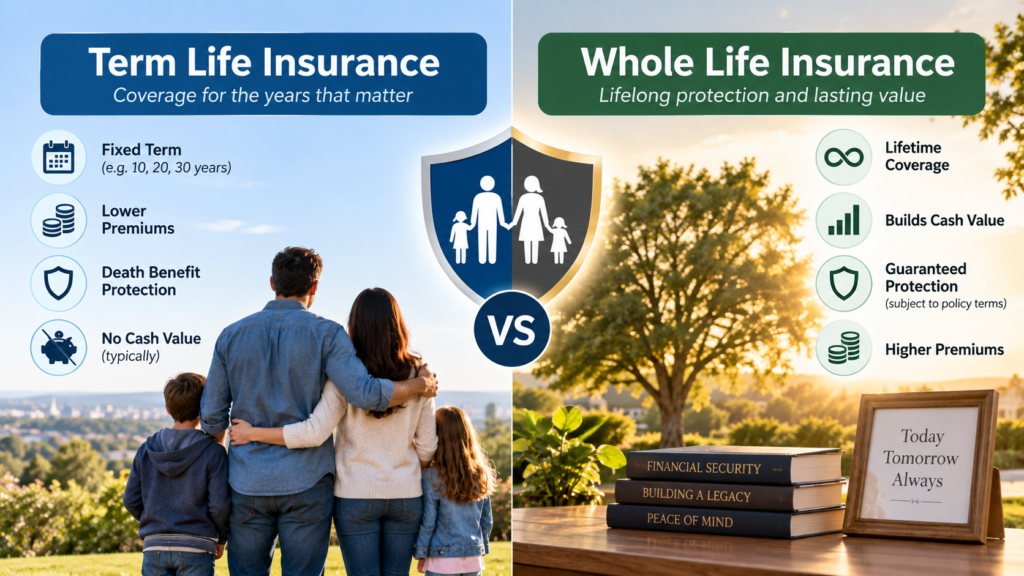
Both can provide a death benefit to beneficiaries when policy requirements are met, but they are designed differently. Term life insurance provides coverage for a specified period, while whole life insurance is a form of permanent life insurance that can remain in force for life if required premiums are paid and policy conditions are satisfied. Whole life policies also typically include a cash-value component.
Understanding these differences can help you ask better questions and decide which type of coverage may be more appropriate for your needs, budget, and financial goals.
What Is Term Life Insurance?
Term life insurance provides life insurance protection for a specified period, known as the policy term.
Common term lengths may include 10, 20, or 30 years, although available options vary by insurer and product.
If the insured person dies while an eligible term policy is in force, the insurer generally pays the policy’s death benefit to the designated beneficiary, subject to the policy terms.
If the insured person outlives the term, coverage generally ends unless the policy is renewed, extended, or converted according to its provisions.
Term life insurance is generally designed primarily to provide death-benefit protection rather than to build cash value.
Why People Consider Term Life Insurance
Term coverage can be useful when someone needs life insurance protection for a particular period.
For example, a person may want coverage while:
- Raising dependent children
- Paying a mortgage
- Repaying significant debts
- Supporting a spouse or partner
- Replacing income during working years
- Paying for children’s future education
- Meeting other temporary financial obligations
Because term insurance generally does not include the same cash-value features found in whole life insurance, its initial premiums may be lower than those of a comparable permanent policy for the same insured person and death benefit.
Actual premiums depend on factors such as age, health, coverage amount, term length, underwriting, tobacco use, and insurer.
What Is Whole Life Insurance?
Whole life insurance is a type of permanent life insurance.
Unlike term insurance, which is designed to cover a specified period, whole life insurance is generally designed to remain in force for the insured person’s lifetime as long as required premiums are paid and policy conditions are met.
Whole life policies typically combine two important features:
- A death benefit
- A cash-value component
Traditional whole life policies may also provide guarantees concerning certain premiums, death benefits, and cash values, depending on the contract.
These additional features generally make whole life insurance more expensive than term insurance when comparing similar initial death benefits.
What Is Cash Value?
Cash value is one of the major differences between term and whole life insurance.
A portion of the value within a whole life policy can accumulate over time according to the terms and guarantees of the contract.
The policy owner may have options for accessing cash value while the insured person is alive.
Depending on the policy, this can include taking a policy loan or making a withdrawal.
However, accessing cash value is not the same as withdrawing money from a normal bank savings account.
Loans, withdrawals, interest, surrender charges, and other policy provisions can affect the cash value and death benefit. A policy loan that remains unpaid may reduce the amount ultimately paid to beneficiaries. In some circumstances, excessive borrowing can also contribute to a policy lapsing.
For these reasons, policy owners should understand the consequences before accessing cash value.
Term Life vs. Whole Life Insurance: Key Differences
The main differences become easier to understand when you compare the purpose and structure of each type of coverage.
Coverage Period
Term life insurance:
Provides coverage for a specified term, such as 10, 20, or 30 years.
Whole life insurance:
Designed to provide permanent coverage that can continue for life when policy requirements are satisfied.
Premiums
Term life insurance:
Initial premiums are often lower for a comparable amount of death-benefit coverage.
Whole life insurance:
Premiums are generally higher because the policy is designed for permanent coverage and includes cash-value features.
Cash Value
Term life insurance:
Generally does not accumulate cash value.
Whole life insurance:
Typically accumulates cash value according to the policy’s terms.
Complexity
Term life insurance:
Usually easier to understand because its primary purpose is death-benefit protection for a defined period.
Whole life insurance:
Can involve additional concepts such as cash value, policy loans, withdrawals, surrender values, dividends on some policies, and other contract provisions.
Length of Need
Term life insurance:
May be appropriate when the financial need is temporary or has a predictable end date.
Whole life insurance:
May be considered when someone has a need or goal that is expected to continue throughout life.
How Term Life Insurance Premiums Work
Many term policies offer level premiums for an initial period.
For example, with a 20-year level term policy, the scheduled premium may remain the same during that 20-year level-premium period, subject to the policy contract.
What happens at the end of the term is important.
Some policies may allow continued or renewable coverage, but premiums can increase substantially as the insured person gets older. Other policies may offer conversion options that allow the owner to convert some or all of the term coverage to permanent life insurance under specified conditions.
Do not assume that a term policy can always be renewed indefinitely at the original premium.
Before purchasing, check:
- How long the premium is guaranteed
- How long the death benefit remains level
- Whether the policy is renewable
- How renewal premiums are determined
- Whether conversion is available
- When conversion rights expire
How Whole Life Insurance Premiums Work
Traditional whole life insurance is commonly structured with premiums that are designed to remain level according to the policy contract.
Because whole life insurance is intended to provide lifelong protection and build cash value, premiums are typically considerably higher than the initial premium for term coverage with a similar death benefit.
This creates an important practical consideration.
A permanent policy only provides its intended benefits if the policy owner can maintain it according to its terms. Purchasing a policy with premiums that become difficult to afford may create problems later.
Before buying whole life insurance, consider whether the premium fits comfortably within your long-term budget.
What Happens When a Term Life Policy Ends?
If you are still alive when the term ends, a standard term life policy generally does not pay the death benefit simply because the term expired.
Depending on the policy, you may have several possibilities.
Let the Coverage End
If the financial need has ended, you may decide that you no longer need the policy.
For example, your children may be financially independent, your mortgage may be substantially reduced or paid off, and your household may have accumulated sufficient assets.
Renew the Policy
Some term policies allow renewal.
However, renewal premiums may be significantly higher because they generally reflect the insured person’s older age and the provisions of the contract.
Convert to Permanent Insurance
Some term policies include a conversion privilege.
This may allow eligible term coverage to be converted to a permanent life insurance policy during a specified period without going through the same type of medical underwriting that might otherwise be required.
Conversion rules vary, so check the policy rather than assuming this option will always be available.
Apply for a New Policy
Another possibility is applying for new coverage.
However, your age and health at that time can affect availability and cost. There is no guarantee that you will qualify for the same coverage or pricing in the future.
What Happens to Whole Life Cash Value?
Cash value generally builds gradually according to the policy contract.
If you surrender a whole life policy, you may receive its available cash surrender value after applicable policy adjustments, loans, charges, or other amounts.
Surrendering a policy normally terminates the life insurance protection.
Tax consequences may also arise in certain situations when cash is withdrawn, a policy is surrendered, or a policy with outstanding loans lapses. Because individual tax circumstances vary, consider consulting an appropriate tax professional when tax consequences are relevant.
Policy Loans: Understand the Trade-Off
The ability to borrow against available cash value can make whole life insurance attractive to some consumers, but policy loans should be understood carefully.
A policy loan generally accrues interest.
If the loan and accumulated interest are not repaid, they can reduce the policy’s available cash value and the death benefit ultimately paid to beneficiaries.
A large outstanding loan can also increase the risk of the policy lapsing if the remaining value is insufficient to support the contract.
Before taking a policy loan, ask the insurer how the loan will affect:
- Cash value
- Interest charges
- Death benefit
- Policy guarantees
- Future premiums or funding requirements
- Risk of policy lapse
What About Whole Life Dividends?
Some whole life policies are described as participating policies and may be eligible to receive dividends.
Dividends are not the same as guaranteed policy benefits and generally should not be assumed unless the contract specifically guarantees a feature.
When dividends are paid, available options may include receiving them in cash, using them toward premiums, leaving them with the insurer under an available option, or purchasing additional insurance.
Options vary by insurer and policy.
If an insurance illustration shows future dividends, distinguish carefully between guaranteed values and non-guaranteed assumptions.
Understanding Life Insurance Illustrations
Permanent life insurance can be more complex than term coverage, so illustrations deserve careful attention.
An illustration may show how policy values could develop over time under certain assumptions.
When reviewing one, look separately at:
- Guaranteed values
- Non-guaranteed values
- Premium assumptions
- Death-benefit projections
- Cash-value projections
- Dividend assumptions, if applicable
- Loan assumptions
- Surrender values
Do not treat non-guaranteed projections as promises.
Ask the licensed insurance professional to explain which figures are guaranteed by the contract and which depend on future assumptions.
Advantages of Term Life Insurance
Depending on your circumstances, term life insurance can offer several potential advantages.
Lower Initial Cost
Term coverage often allows consumers to purchase a relatively large death benefit for a lower initial premium than comparable permanent coverage.
Simpler Structure
Term insurance is generally easier to understand because its primary purpose is providing a death benefit during a defined coverage period.
Useful for Temporary Financial Needs
A term can be matched approximately to a financial obligation.
For example, a parent with young children might consider coverage intended to last through the years when the household is most dependent on that parent’s income.
Flexibility in Coverage Amount
The lower initial cost may make it practical for some households to obtain a larger death benefit during their highest-need years.
Potential Limitations of Term Life Insurance
Term life insurance also has limitations.
Coverage Can Expire
If you still need life insurance after the term ends, obtaining continued coverage may be more expensive.
Renewal Can Be Costly
Renewable policies may become substantially more expensive at older ages.
No Typical Cash-Value Accumulation
Most term insurance is designed for death-benefit protection rather than accumulating cash value.
Future Insurability Can Matter
If your term ends and your health has changed, purchasing a new policy may be more difficult or expensive. Conversion provisions can therefore be important for some consumers.
Advantages of Whole Life Insurance
Whole life insurance may offer advantages for certain long-term needs.
Permanent Coverage
It is designed to remain in force for life when required premiums are paid and policy conditions are satisfied.
Cash-Value Component
The policy typically accumulates cash value according to its contract.
Certain Guarantees
Traditional whole life policies may provide guaranteed elements such as specified premiums, death benefits, and cash values, depending on the policy.
Long-Term Planning
Permanent coverage may be useful for certain lifelong financial needs where coverage is expected to be needed regardless of age.
Potential Limitations of Whole Life Insurance
Whole life insurance is not automatically the better choice simply because it can last longer.
Higher Premiums
The cost can be significantly higher than term life insurance for a comparable initial death benefit.
Greater Complexity
Cash value, loans, withdrawals, surrender provisions, dividends, and policy illustrations make the product more complicated.
Long-Term Commitment
Because premiums may be substantial, buyers should consider whether they can comfortably maintain the policy over the long term.
Early Surrender May Be Unattractive
Cash surrender value during the earlier years of a policy may be considerably less than the total premiums paid. Exact values depend on the contract.
When Might Term Life Insurance Make Sense?
Term life insurance may be worth considering when your primary goal is affordable death-benefit protection for a defined period.
Examples can include someone who wants to:
- Replace employment income while children are dependent
- Protect a spouse or partner during working years
- Cover a mortgage or other significant debt
- Provide funds for children’s education
- Maintain substantial coverage while household savings are still growing
These are examples, not recommendations for every household.
Your individual financial circumstances determine how much coverage and what type of policy may be appropriate.
When Might Whole Life Insurance Make Sense?
Whole life insurance may be considered when the need for life insurance is expected to be permanent and the policy owner understands and values the permanent-policy features.
Potential situations might involve:
- A lifelong need for death-benefit protection
- Certain estate or legacy goals
- Providing funds for final expenses
- Specific long-term family financial planning
- A desire for guaranteed cash-value features offered by a particular policy
Permanent life insurance can be complex, particularly when used as part of broader financial or estate planning. Professional financial, legal, or tax guidance may be appropriate depending on the situation.
Can You Own Both Term and Whole Life Insurance?
Yes. Life insurance choices do not necessarily have to be all-or-nothing.
Some people may use different types of policies for different financial needs.
For example, someone could have permanent coverage intended for a lifelong need while also carrying additional term insurance during the years when children are dependent or a large mortgage remains outstanding.
Whether this approach makes sense depends on your needs, budget, existing coverage, and financial plan.
How Much Life Insurance Do You Need?
There is no universal amount of life insurance that is appropriate for everyone.
Instead of relying solely on a simple income multiple, consider the financial responsibilities the death benefit would need to address.
These might include:
- Income replacement
- Mortgage balance
- Other debts
- Children’s education
- Childcare expenses
- Final expenses
- Ongoing household expenses
- Financial support for dependents
- Existing savings and investments
- Existing employer or individual life insurance
Your coverage needs can change as your financial situation changes.
Review your coverage periodically rather than assuming the amount you purchase today will remain appropriate indefinitely.
If you are exploring coverage, you can also review our life insurance options guide to better understand the basic factors to consider before comparing policies.
Questions to Ask Before Buying Term Life Insurance
Before purchasing term coverage, consider asking:
- How long does the coverage last?
- Is the premium level for the entire term?
- Does the death benefit remain level?
- Can the policy be renewed?
- What happens to the premium after the initial term?
- Is the policy convertible to permanent insurance?
- When does the conversion option expire?
- Are there limitations on which permanent policies I can convert to?
- Are any optional riders available?
- What circumstances could cause the policy to lapse?
Questions to Ask Before Buying Whole Life Insurance
For whole life insurance, consider asking:
- Which policy values are guaranteed?
- How does the cash value grow?
- Are premiums guaranteed?
- Is the death benefit guaranteed?
- Is the policy participating or non-participating?
- Are dividends shown in the illustration guaranteed?
- What is the cash surrender value during the early years?
- How do policy loans work?
- What interest rate applies to loans?
- How would an outstanding loan affect the death benefit?
- What happens if I stop paying premiums?
- What charges or adjustments apply if I surrender the policy?
Understanding these details before purchasing can help prevent surprises later.
Term Life vs. Whole Life: Which Is Better?
Neither type of insurance is universally better.
The more useful question is which type better matches the financial need you are trying to protect.
Term life insurance may appeal to someone whose priority is obtaining substantial death-benefit protection during a defined period while keeping initial premiums lower.
Whole life insurance may appeal to someone who needs permanent coverage, can comfortably afford the higher premiums, and values the guarantees and cash-value features of the particular policy.
Avoid choosing solely because one policy is described as an “investment” or because another is described as “cheap.”
Instead, consider:
- Why you need life insurance
- How long you need coverage
- How much death benefit you need
- What premium you can sustainably afford
- Whether you need permanent coverage
- Whether cash value is relevant to your goals
- Which features are guaranteed
- What happens if your circumstances change
Compare More Than the Premium
When comparing life insurance policies, price is important, but it is not the only factor.
Consider the insurer, policy type, death benefit, premium guarantees, term length, conversion provisions, riders, exclusions, cash-value provisions, surrender terms, and other contract details.
For permanent policies, pay particular attention to the distinction between guaranteed and non-guaranteed values.
If you do not understand a feature, ask for an explanation before purchasing.
Review Your Beneficiaries
Choosing a life insurance policy is only part of the process.
You also need to designate beneficiaries and keep those designations current.
Review your beneficiary information after major life events such as:
- Marriage
- Divorce
- Birth or adoption of a child
- Death of a beneficiary
- Significant changes in family circumstances
Beneficiary designations can have important financial and legal consequences. Consider appropriate professional guidance for complicated family, estate, or trust arrangements.
Review Your Life Insurance as Your Needs Change
Life insurance needs are not necessarily permanent at the same amount.
Consider reviewing your coverage after major changes such as:
- Marriage
- Having a child
- Buying a home
- Taking on significant debt
- Changing jobs
- Starting a business
- Divorce
- Retirement
- Paying off a mortgage
- Becoming responsible for another dependent
A policy that was suitable when you purchased it may need to be reconsidered years later.
Frequently Asked Questions
Is term life insurance cheaper than whole life insurance?
Term life insurance generally has a lower initial premium than whole life insurance for a comparable death benefit and insured person because it provides coverage for a defined period and generally does not build cash value. Actual pricing varies by insurer and applicant.
Does term life insurance have cash value?
Most traditional term life insurance does not accumulate cash value. Its primary purpose is to provide death-benefit protection during the policy term.
Does whole life insurance expire?
Whole life insurance is designed as permanent coverage and can generally remain in force for the insured person’s lifetime when required premiums are paid and policy conditions are satisfied.
What happens if I outlive my term life insurance?
With standard term life insurance, coverage generally ends when the term expires unless the policy is renewed, extended, or converted according to its provisions. A death benefit is not normally paid simply because the insured person outlives the term.
Can I convert term life insurance to whole life insurance?
Some term policies include conversion privileges that allow eligible coverage to be converted to a permanent policy during a specified period. Availability, deadlines, and eligible permanent products vary by policy and insurer.
Can I borrow money from a whole life policy?
Whole life policies with sufficient cash value may permit policy loans. Loans generally accrue interest and can reduce cash value and the death benefit if they remain unpaid. They may also increase the risk of lapse in some circumstances.
Is whole life cash value guaranteed?
Traditional whole life policies may include guaranteed cash values according to the policy contract, while other illustrated elements may not be guaranteed. Review the actual policy and illustration carefully.
Does whole life insurance always pay a death benefit?
A death benefit depends on the policy remaining in force and the terms of the contract. Policy loans, withdrawals, lapse, surrender, exclusions, and other provisions can affect coverage or the amount payable.
Should everyone buy whole life insurance?
No single life insurance product is appropriate for everyone. The appropriate choice depends on the purpose of the coverage, duration of need, budget, financial circumstances, and policy features.
Can I have more than one life insurance policy?
Yes. A person can potentially own multiple policies, subject to underwriting and the insurer’s assessment of appropriate coverage. Some households use different policies to address different financial needs.
The Bottom Line
Term life and whole life insurance can both provide valuable death-benefit protection, but they are designed for different needs.
Term life insurance provides coverage for a specified period and generally offers a simpler structure and lower initial premiums for a comparable death benefit. It may be useful when your largest financial responsibilities have a foreseeable end date.
Whole life insurance is designed to provide permanent coverage and typically includes a cash-value component. In exchange for these additional features and long-term guarantees, premiums are generally higher.
Before choosing between them, identify why you need life insurance, how long the need is likely to last, how much coverage you require, and what premium you can sustainably afford.
For whole life or other permanent policies, carefully review guaranteed and non-guaranteed values, cash-value provisions, loans, surrender terms, and illustrations.
Life insurance is a long-term financial commitment. Read the actual policy documents carefully and consider speaking with a licensed insurance professional when you need advice based on your individual circumstances.