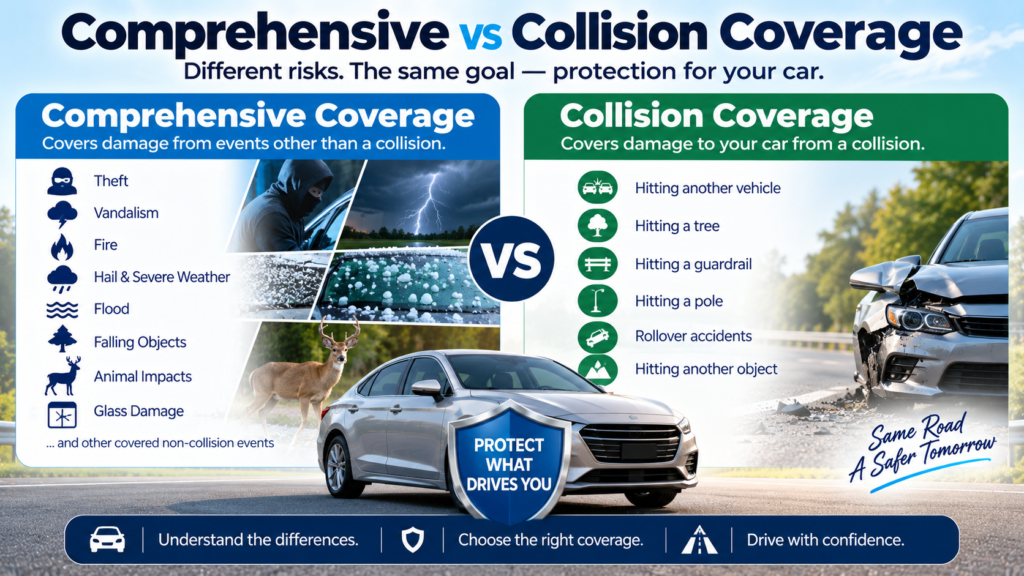
Comprehensive vs Collision Coverage
Comprehensive and collision insurance are two important types of auto coverage that can help protect your own vehicle.
Although they are often purchased together, they cover different kinds of losses.
In simple terms:
- Collision coverage generally helps pay for damage to your vehicle caused by a collision.
- Comprehensive coverage generally helps pay for certain damage to your vehicle caused by events other than a collision.
Understanding the difference can help you decide whether you need one, both, or neither based on your vehicle, finances, lender requirements, deductible choices, and risk tolerance.
What Is Collision Coverage?
Collision coverage generally helps pay to repair or replace your insured vehicle after certain covered collision-related losses.
Examples can include:
- Hitting another vehicle
- Hitting a tree
- Hitting a guardrail
- Hitting a pole
- Hitting another object
- Certain rollover accidents
Collision coverage is focused primarily on physical damage to your own insured vehicle.
It is separate from liability insurance.
Collision Coverage Example
Suppose you lose control of your vehicle on a wet road and hit a guardrail.
Your vehicle suffers $6,000 in covered damage.
If you have collision coverage with a $1,000 deductible, your insurer may pay the eligible amount above the deductible according to the policy terms.
In this simplified example:
- Covered repair cost: $6,000
- Collision deductible: $1,000
- Potential insurer payment: $5,000
Actual claim payments depend on the policy, repair costs, vehicle valuation, applicable limits, exclusions, and claim circumstances.
What Is Comprehensive Coverage?
Comprehensive coverage generally helps protect your insured vehicle against certain losses that are not caused by a collision.
It is sometimes described as “other than collision” coverage.
Common examples may include:
- Theft
- Vandalism
- Fire
- Hail
- Windstorm
- Flood
- Falling objects
- Animal impacts
- Certain glass damage
- Other covered non-collision events
The exact scope depends on your policy.
Comprehensive Coverage Example
Suppose your vehicle is parked outside during a severe hailstorm.
The storm causes $4,000 in eligible damage.
If your comprehensive deductible is $500, your insurer may pay the eligible amount above the deductible according to the policy.
In this simplified example:
- Covered damage: $4,000
- Comprehensive deductible: $500
- Potential insurer payment: $3,500
Again, actual payments depend on the terms of your policy and the details of the claim.
Comprehensive vs Collision: The Main Difference
The easiest way to understand the difference is to focus on what caused the damage.
Collision
Generally applies when your vehicle is damaged because it collides with:
- Another vehicle
- An object
- A structure
- Certain road hazards
- Or rolls over
Comprehensive
Generally applies when your vehicle is damaged by certain events outside of a typical collision, such as:
- Theft
- Fire
- Hail
- Wind
- Flood
- Vandalism
- Falling objects
- Animal impacts
The distinction is based primarily on the cause of the loss, not simply how expensive the damage is.
For a broader explanation of common policy types and protection options, review our auto insurance guide.
Collision vs Comprehensive Comparison
| Feature | Collision | Comprehensive |
|---|---|---|
| Damage from hitting another car | Generally yes | Generally no |
| Damage from hitting a tree or pole | Generally yes | Generally no |
| Vehicle rollover | Generally yes | Generally no |
| Theft | No | Generally yes |
| Vandalism | No | Generally yes |
| Fire | No | Generally yes |
| Hail | No | Generally yes |
| Flood | No | Generally yes |
| Falling object | No | Generally yes |
| Animal impact | Usually comprehensive | Generally yes |
| Deductible commonly applies | Yes | Yes |
| Required by most state laws | Generally no | Generally no |
| May be required by lender | Yes | Yes |
Coverage varies by insurer, policy form, and state, so always review the actual policy.
Does Collision Cover Damage to Another Person’s Car?
Generally, no.
Collision coverage primarily protects your own insured vehicle.
If you are legally responsible for damaging another person’s vehicle, property damage liability coverage is generally the relevant part of your auto policy.
This distinction is important.
Collision
Protects your vehicle against certain covered collision damage.
Property Damage Liability
Helps address covered damage you cause to someone else’s property.
These are separate coverages.
Does Comprehensive Cover Another Person’s Vehicle?
Generally, no.
Comprehensive coverage is designed to protect your insured vehicle against certain covered non-collision losses.
If you damage another person’s vehicle or property and are legally responsible, liability insurance is generally the relevant coverage.
Does Collision Cover an Accident You Cause?
Collision coverage can generally apply to covered damage to your own insured vehicle even when you are responsible for the collision, subject to the policy terms and deductible.
For example, if you accidentally hit a pole and damage your own car, collision coverage may apply.
Liability coverage would not generally pay to repair your own vehicle in that situation.
Does Collision Cover an Accident That Is Not Your Fault?
Collision coverage may also potentially apply to damage to your insured vehicle after a collision caused by another driver.
How the claim is handled can depend on:
- State law
- Your policy
- The other driver’s insurance
- Fault determination
- Available coverage
- Deductibles
- Insurer procedures
If you use your own collision coverage, a deductible may initially apply.
Your insurer may later pursue recovery from the responsible party where appropriate.
Do not assume the exact claims process is the same in every state or situation.
Does Comprehensive Cover Theft?
Vehicle theft is one of the commonly recognized risks covered by comprehensive insurance.
If your vehicle is stolen and the loss is covered, the insurer will generally evaluate the vehicle according to the policy’s valuation and claim terms.
The deductible may apply.
Comprehensive coverage does not guarantee reimbursement of the amount you originally paid for the vehicle or the remaining loan balance.
Does Comprehensive Cover Vandalism?
Comprehensive insurance generally covers eligible vandalism damage.
Examples might include:
- Scratched paint
- Broken windows
- Deliberate body damage
- Other intentional damage caused by someone else
Claims remain subject to the deductible, exclusions, policy conditions, and insurer investigation.
Does Comprehensive Cover Hail Damage?
Hail damage is commonly covered under comprehensive insurance.
This can include damage to:
- Body panels
- Roof
- Hood
- Trunk
- Windows
- Windshield
Whether it makes financial sense to file a claim may depend on the repair cost compared with your deductible.
Does Comprehensive Cover Flood Damage?
Comprehensive coverage generally includes certain flood-related vehicle damage.
This is different from homeowners insurance, where flood coverage often involves different arrangements.
For an automobile, comprehensive coverage is typically the coverage associated with eligible flood damage to the insured vehicle.
Policy terms still apply.
Does Comprehensive Cover Fire?
Comprehensive insurance generally covers eligible fire damage to the insured vehicle.
Possible scenarios can include:
- External fire
- Wildfire
- Certain vehicle fires
The cause of the fire and policy exclusions can affect coverage.
Does Comprehensive Cover Falling Trees?
If a tree or tree branch falls onto a parked vehicle, comprehensive coverage will generally be the relevant coverage.
If you are driving and collide with a fallen tree already lying in the roadway, the claim may be treated differently depending on the circumstances and policy.
The precise cause of the damage matters.
Does Comprehensive Cover Animal Damage?
Comprehensive coverage generally applies when your vehicle strikes an animal, such as a deer.
This sometimes surprises drivers because an animal impact physically feels like a collision.
However, animal impacts are commonly handled under comprehensive coverage.
Damage caused by animals in other circumstances may also potentially be covered, depending on the policy.
Does Comprehensive Cover Windshield Damage?
Comprehensive insurance can generally cover eligible windshield and glass damage.
Examples can include:
- Rock damage
- Cracked windshield
- Hail damage
- Falling objects
- Vandalism
Some insurers or states may offer different glass deductibles or separate glass coverage arrangements.
Check your policy rather than assuming your standard comprehensive deductible always applies.
Does Collision Cover Pothole Damage?
Collision coverage can generally apply to vehicle damage caused by hitting a pothole, subject to the policy terms and deductible.
Before filing a claim, compare:
- Estimated repair cost
- Collision deductible
- Potential claim implications
- Policy terms
If the damage is only slightly above the deductible, filing a claim may provide limited immediate financial benefit.
What Is a Comprehensive Deductible?
A comprehensive deductible is the amount you generally pay toward an eligible comprehensive claim before the insurer pays the remaining covered amount.
For example:
- Covered damage: $2,500
- Deductible: $500
- Potential insurer payment: $2,000
Comprehensive deductible options vary by insurer.
Common options may include:
- $100
- $250
- $500
- $1,000
Available amounts differ by policy and insurer.
What Is a Collision Deductible?
A collision deductible works in a similar way.
Suppose your vehicle suffers $7,000 of eligible collision damage and your collision deductible is $1,000.
A simplified calculation would be:
- Covered damage: $7,000
- Deductible: $1,000
- Potential insurer payment: $6,000
Actual settlements depend on the policy, valuation, repair estimates, and claim circumstances.
Do Comprehensive and Collision Have to Use the Same Deductible?
Not necessarily.
An insurer may allow you to select different deductibles for comprehensive and collision.
For example:
- Comprehensive deductible: $250
- Collision deductible: $1,000
This may be useful because the types and frequency of claims associated with each coverage differ.
Compare the premium difference among available deductible combinations.
Higher vs Lower Deductibles
A higher deductible generally lowers your premium because you agree to absorb more of an eligible loss.
A lower deductible generally increases the premium but reduces the amount you must pay toward an eligible claim.
For example:
Lower Deductible
Potential advantages:
- Less money required after an eligible claim
- Easier to handle smaller covered losses
Potential disadvantage:
- Higher premium
Higher Deductible
Potential advantages:
- Lower premium
- May reduce annual insurance cost
Potential disadvantage:
- More out-of-pocket expense after an eligible claim
Choose a deductible that you could realistically afford without creating financial hardship.
Are Comprehensive and Collision Required by Law?
States generally do not require comprehensive or collision coverage simply for you to legally drive.
State auto insurance requirements are usually focused on liability or other mandatory coverages.
However, that does not mean comprehensive and collision are always optional for every driver.
If your vehicle is financed or leased, your contract may require them.
Why Do Lenders Require Comprehensive and Collision?
When a lender finances your vehicle, the lender has a financial interest in the car.
If the vehicle is:
- Stolen
- Destroyed by fire
- Severely damaged in a crash
- Totaled by another covered event
the lender still has money at risk.
Requiring comprehensive and collision helps protect the financed asset.
The requirement usually continues until the applicable loan is paid off or otherwise satisfied.
Do Leased Cars Need Comprehensive and Collision?
Leasing companies commonly require comprehensive and collision coverage.
A lease agreement may also specify:
- Maximum allowed deductibles
- Liability limits
- Additional insurance requirements
Always review the lease contract.
State minimum insurance alone may not satisfy the lease requirements.
What Happens If You Drop Required Coverage on a Financed Car?
Dropping lender-required comprehensive or collision coverage may violate your loan agreement.
Potential consequences can depend on the lender and contract.
A lender may obtain its own limited protection for its financial interest and charge you for it, or take other actions permitted under the agreement.
That type of lender protection may not provide the same protection to you as a normal personal auto insurance policy.
Do not intentionally remove required coverage without reviewing your financing agreement.
Do You Need Comprehensive and Collision After Paying Off Your Car?
Once the applicable vehicle loan is fully paid, a lender generally no longer requires you to maintain comprehensive and collision.
You then have more flexibility.
But paying off the car does not automatically mean dropping the coverages is the best decision.
Consider:
- Current vehicle value
- Comprehensive premium
- Collision premium
- Deductibles
- Your savings
- Your ability to replace the vehicle
- Dependence on the vehicle
- Local weather and theft risks
The right answer can differ from one driver to another.
When Might Collision Coverage Make Sense?
Collision may be worth considering if:
- Your vehicle has significant market value
- You depend heavily on the vehicle
- You could not comfortably replace it
- Major repairs would create financial hardship
- The vehicle is financed or leased
- The premium is reasonable relative to the protection
The age of the vehicle alone does not determine whether collision is worthwhile.
When Might Comprehensive Coverage Make Sense?
Comprehensive may be valuable if you are concerned about risks such as:
- Theft
- Severe weather
- Hail
- Flooding
- Wildfire
- Vandalism
- Falling objects
- Animal collisions
- Glass damage
A vehicle can be old and still face significant comprehensive risks.
This is one reason some drivers may choose to keep comprehensive even after considering dropping collision.
Can You Have Comprehensive Without Collision?
Some insurers may allow comprehensive coverage without collision.
Availability depends on the insurer and policy.
A driver with an older paid-off vehicle might decide that:
- Collision protection is no longer worth the cost
- But theft, weather, animal, or glass protection still has value
Do not assume every insurer allows every combination.
Check available options.
Can You Have Collision Without Comprehensive?
Availability can vary by insurer.
Some companies may permit certain physical-damage coverage combinations, while others may have underwriting rules about how the coverages are offered.
If your vehicle is financed or leased, the lender will commonly require both.
Comprehensive vs Collision for an Older Car
Older vehicles require a more careful cost-benefit evaluation.
Consider:
- Actual cash value
- Annual collision premium
- Annual comprehensive premium
- Deductibles
- Repair costs
- Replacement ability
Suppose a vehicle is worth only a few thousand dollars.
If collision coverage is expensive and has a high deductible, the maximum practical benefit from a future claim may be relatively limited.
That does not automatically mean the coverage should be removed.
It means the numbers deserve review.
Comprehensive vs Collision for a New Car
For a new vehicle, both coverages often have greater practical importance because the vehicle has substantial value.
If financed or leased, both will commonly be required.
Even when the car is owned outright, ask whether you could absorb the financial loss of:
- A serious crash
- Theft
- Fire
- Hail
- Flood
- Another covered event
For many owners of newer vehicles, losing physical-damage coverage would mean accepting significant risk.
Comprehensive vs Collision for a Paid-Off Car
Once the vehicle is paid off, compare the cost of protection with the vehicle’s current value.
A useful question is:
If my car were totaled tomorrow and I had no physical-damage coverage, could I comfortably replace it?
If the answer is no, maintaining comprehensive and collision may still provide meaningful financial protection.
If the answer is yes, you may choose to evaluate whether continuing one or both coverages is worth the premium.
What Happens if Your Car Is Totaled?
If your vehicle suffers a covered loss and the insurer determines that it is a total loss, the claim is generally settled based on the applicable vehicle valuation provisions in the policy.
The payout is not automatically:
- The original purchase price
- The amount you still owe
- The cost of a brand-new replacement vehicle
The deductible may also apply.
This is especially important for financed vehicles.
Comprehensive and Collision vs Gap Insurance
Comprehensive and collision protect the vehicle against different covered physical-damage losses.
Gap-related protection addresses a different issue.
Suppose:
- Your financed vehicle is totaled
- The applicable insurance settlement is less than the amount you still owe
Comprehensive or collision may pay according to the vehicle’s covered value, depending on the cause of loss.
Gap protection may help address an eligible difference between the settlement and certain remaining loan or lease obligations, subject to the gap product’s terms.
These are not interchangeable coverages.
Does Comprehensive or Collision Cover Mechanical Breakdown?
Generally, normal wear, routine maintenance, and ordinary mechanical breakdown are not the purpose of comprehensive or collision coverage.
Examples can include:
- Worn brakes
- Aging battery
- Normal engine wear
- Routine maintenance
- Mechanical failure unrelated to a covered event
Different products, warranties, or service contracts may address certain mechanical problems.
Do not assume normal auto insurance replaces maintenance.
Does Comprehensive Cover Flooding From a Hurricane?
Eligible flood or storm-related vehicle damage is generally associated with comprehensive coverage.
For example, if a hurricane causes floodwater to damage your insured vehicle, comprehensive may apply subject to the policy.
However, insurance generally needs to be in force before the loss.
Insurers may restrict new coverage changes when a major storm is imminent or underway.
Do not wait until a known disaster is approaching to evaluate insurance protection.
Does Collision Cover Hit-and-Run Damage?
Collision coverage may potentially pay for eligible damage to your insured vehicle after a hit-and-run collision, subject to the deductible and policy.
Depending on the state and policy, uninsured motorist property damage may also be relevant in certain situations.
Because these rules vary substantially, review your state’s requirements and your actual coverage.
What if Someone Hits Your Parked Car?
The appropriate coverage depends on what happened and which insurance is available.
Possibilities may include:
- The responsible driver’s property damage liability
- Your collision coverage
- Certain uninsured motorist property damage coverage where available
If your parked vehicle is damaged by vandalism rather than another vehicle, comprehensive would generally be the more relevant coverage.
The cause of damage matters.
Collision With an Animal: Collision or Comprehensive?
A direct collision with an animal such as a deer is generally handled under comprehensive coverage.
This is one of the most common examples where the everyday meaning of “collision” differs from the insurance coverage category.
If your car swerves to avoid a deer and then hits a tree, collision coverage may be relevant instead.
Claims depend on the actual sequence of events and policy terms.
Falling Tree: Comprehensive or Collision?
If a tree falls onto your parked vehicle, comprehensive coverage generally applies.
If you drive into a tree lying in the roadway, collision coverage may apply.
Again, the difference comes down to the cause of the loss.
Road Debris: Comprehensive or Collision?
Road-debris claims can depend heavily on what happened.
For example:
- An object falling onto your vehicle may be treated differently from
- Driving into an object already lying on the road
The specific facts and policy language determine which coverage applies.
If you are uncertain, report the event accurately to the insurer and allow the claims process to determine the applicable coverage.
Is Comprehensive Cheaper Than Collision?
Comprehensive coverage is often less expensive than collision coverage, but this is not guaranteed.
Premiums depend on factors including:
- Vehicle
- Location
- Claims experience
- Deductible
- Insurer
- Coverage choices
- Other rating factors allowed in the state
Always compare actual quotes.
What Affects the Cost of Comprehensive Coverage?
Potential factors can include:
- Vehicle value
- Theft risk
- Local weather
- Glass repair costs
- Claims experience
- Comprehensive deductible
- Location
- Insurer pricing
Different companies can price the same vehicle differently.
What Affects the Cost of Collision Coverage?
Potential factors can include:
- Vehicle value
- Repair costs
- Crash claims
- Driver characteristics
- Location
- Vehicle use
- Deductible
- Insurer pricing
Modern vehicles with expensive sensors, cameras, lighting systems, body components, and advanced technology can cost more to repair after a collision.
Should You Choose a $500 or $1,000 Deductible?
There is no universal correct answer.
Compare:
$500 Deductible
- Higher potential premium
- Lower out-of-pocket cost after an eligible claim
$1,000 Deductible
- Lower potential premium
- Higher out-of-pocket cost after an eligible claim
Ask how much money you could comfortably pay after an unexpected loss.
Then compare the actual premium savings.
Do not increase your deductible only because a higher number produces the lowest quote.
When Is a Comprehensive Claim Worth Filing?
There is no fixed dollar threshold that works for everyone.
Consider:
- Estimated damage
- Deductible
- Policy terms
- Vehicle value
- Your ability to pay for repairs
- Claims considerations
For example, filing a $600 covered claim with a $500 deductible would have very different economics from filing a $5,000 covered claim with the same deductible.
When Is a Collision Claim Worth Filing?
The same principle applies.
Compare:
- Repair estimate
- Collision deductible
- Vehicle value
- Claim circumstances
- Available other insurance
A claim may make sense when the eligible loss substantially exceeds the deductible, but each situation is different.
Do Comprehensive or Collision Claims Affect Premiums?
A claim can potentially affect future insurance pricing, but the outcome depends on:
- State law
- Claim type
- Fault
- Insurer
- Claims history
- Policy rules
- Other rating factors
Do not assume every claim automatically produces the same premium increase.
If you are considering a small claim, ask your insurer or agent about the claims process, but understand that future pricing cannot always be predicted in advance.
How to Decide Whether You Need Both
Use this practical process.
Step 1: Determine Whether a Lender Requires Them
If your vehicle is financed or leased, review the contract first.
Step 2: Estimate Your Vehicle’s Current Value
Do not base the decision only on what you originally paid.
Step 3: Check the Premium for Each Coverage
Ask how much you pay specifically for:
- Comprehensive
- Collision
Step 4: Review Your Deductibles
Know how much of an eligible claim you would pay yourself.
Step 5: Evaluate Your Replacement Ability
Could you replace the car without insurance if it were stolen or totaled?
Step 6: Consider Local Risks
Think about:
- Severe weather
- Flood
- Hail
- Theft
- Animal collisions
- Traffic conditions
Step 7: Compare Multiple Options
Request quotes with different deductible and physical-damage coverage combinations.
This can show you the actual cost of transferring more or less risk to the insurer.
Example: Keeping Both Coverages
Suppose a paid-off vehicle is worth $20,000.
The owner depends on it for work and does not have enough savings to replace it comfortably.
Even without a lender requirement, comprehensive and collision may provide significant financial protection.
The owner can then compare several deductible options to manage the premium.
Example: Dropping Collision but Keeping Comprehensive
Suppose an older vehicle has a lower market value.
The owner could replace the vehicle if it were damaged in a crash, so collision coverage is becoming difficult to justify.
However, comprehensive coverage is relatively inexpensive, and the owner lives in an area with substantial hail and theft risk.
If the insurer permits the combination, the owner might consider keeping comprehensive while dropping collision.
This is an individual cost-and-risk decision, not a universal recommendation.
Example: Liability-Only Coverage
Suppose another driver owns a low-value vehicle outright and has enough savings to replace it.
The driver decides to accept the risk of damage to the vehicle and removes both comprehensive and collision.
The driver still maintains appropriate legally required liability and other required coverages.
This illustrates an important point:
Dropping physical-damage coverage does not mean you no longer need liability insurance.
Comprehensive and Collision Are Not Liability Insurance
This distinction is critical.
Liability
Protects against certain covered claims for injuries or property damage you cause to others.
Collision
Protects your insured vehicle from certain collision-related damage.
Comprehensive
Protects your insured vehicle from certain non-collision losses.
A policy can include all three, but they perform different jobs.
What Does “Full Coverage” Have to Do With Comprehensive and Collision?
“Full coverage” commonly refers to an auto policy containing:
- Liability
- Comprehensive
- Collision
But “full coverage” is not a standardized policy name and does not mean you are insured against every possible loss.
You may still have:
- Liability limits
- Deductibles
- Exclusions
- Coverage conditions
- Optional coverage not included
Always compare the actual policy rather than relying only on the phrase “full coverage.”
Questions to Ask Your Insurer
Before selecting comprehensive and collision coverage, ask:
- What does my collision coverage include?
- What does my comprehensive coverage include?
- What events are excluded?
- What deductible options are available?
- Can I choose different deductibles?
- Is glass subject to the same deductible?
- How is a totaled vehicle valued?
- Does my lender require both coverages?
- Is there a maximum deductible allowed by my lender?
- Can I carry comprehensive without collision?
- What is the premium for each coverage separately?
- What optional endorsements are available?
These questions can help you understand what you are actually buying.
Common Mistakes to Avoid
Assuming Comprehensive Means Everything
Despite its name, comprehensive insurance does not literally cover every possible loss.
Confusing Collision With Liability
Collision protects your vehicle. Liability generally protects against covered damage you cause to others.
Dropping Coverage While a Lender Requires It
Check the loan or lease agreement before removing physical-damage protection.
Choosing a Deductible You Cannot Afford
Premium savings are not helpful if the deductible becomes impossible to pay after a claim.
Keeping Coverage Forever Without Reviewing Vehicle Value
As vehicles age and depreciate, periodically reassess the economics of physical-damage coverage.
Dropping Coverage Just Because the Car Is Old
Age alone does not determine whether coverage still has value.
Assuming a Total-Loss Settlement Pays the Loan Balance
Vehicle insurance settlement and remaining loan balance are different concepts.
Comparing Quotes With Different Deductibles
A policy with a $1,000 deductible should not be treated as directly equivalent to one with a $250 deductible.
Frequently Asked Questions
What is the difference between comprehensive and collision insurance?
Collision generally covers eligible damage to your own vehicle caused by collisions, while comprehensive generally covers certain non-collision losses such as theft, fire, hail, flood, vandalism, falling objects, and animal impacts.
Do I need both comprehensive and collision?
It depends on your lender requirements, vehicle value, financial situation, premiums, deductibles, and ability to replace or repair your vehicle.
Is comprehensive or collision required by law?
They are generally not required by state law, but lenders and leasing companies commonly require both for financed or leased vehicles.
Which is better: comprehensive or collision?
Neither is universally better because they protect against different risks. A driver may need both depending on the vehicle and circumstances.
Does comprehensive cover accidents?
Comprehensive generally covers certain non-collision losses. Typical vehicle crashes are generally handled under collision coverage.
Does collision cover theft?
No. Vehicle theft is generally associated with comprehensive coverage.
Does comprehensive cover hitting a deer?
Animal impacts are generally handled under comprehensive coverage.
Does collision cover hitting a tree?
If you drive into a tree, collision coverage generally applies. If a tree falls onto your parked car, comprehensive coverage is generally more relevant.
Does comprehensive cover windshield damage?
Comprehensive can generally cover eligible glass and windshield damage, though deductible rules can vary by insurer and state.
Can I have comprehensive without collision?
Some insurers may allow it, particularly on an owned vehicle. Availability depends on the insurer and policy.
Should I drop collision on an old car?
Consider the vehicle’s value, collision premium, deductible, and your ability to replace the vehicle. There is no universal age at which collision should automatically be removed.
Should I keep comprehensive on an old car?
It can still provide useful protection against theft, hail, fire, flood, vandalism, glass damage, and animal impacts. Compare its cost with the value of the protection.
What happens if my financed car is totaled?
The applicable comprehensive or collision coverage may pay according to the policy’s vehicle valuation and deductible, depending on the cause of loss. The insurance settlement does not necessarily equal the amount remaining on your loan.
Is gap insurance the same as comprehensive or collision?
No. Comprehensive and collision protect against covered physical damage to the vehicle. Gap-related protection addresses certain differences between a covered settlement and an eligible remaining loan or lease balance.
The Bottom Line
Comprehensive and collision insurance both protect your own vehicle, but they address different risks.
Collision coverage generally applies when your vehicle is damaged in a collision with another vehicle or object or in certain rollover situations.
Comprehensive coverage generally applies to certain non-collision losses such as:
- Theft
- Fire
- Hail
- Flood
- Vandalism
- Falling objects
- Animal impacts
- Certain glass damage
Neither is generally required simply because of state auto insurance laws, but a lender or leasing company may require both while the vehicle is financed or leased.
For an owned vehicle, deciding whether to keep comprehensive, collision, or both comes down to the vehicle’s value, premium, deductibles, your ability to pay for repairs or replacement, and the risks you are willing to keep yourself.
The best choice is not automatically the option with the most coverage or the lowest premium.
It is the combination that provides a reasonable balance between vehicle protection, deductible, financial risk, and cost.