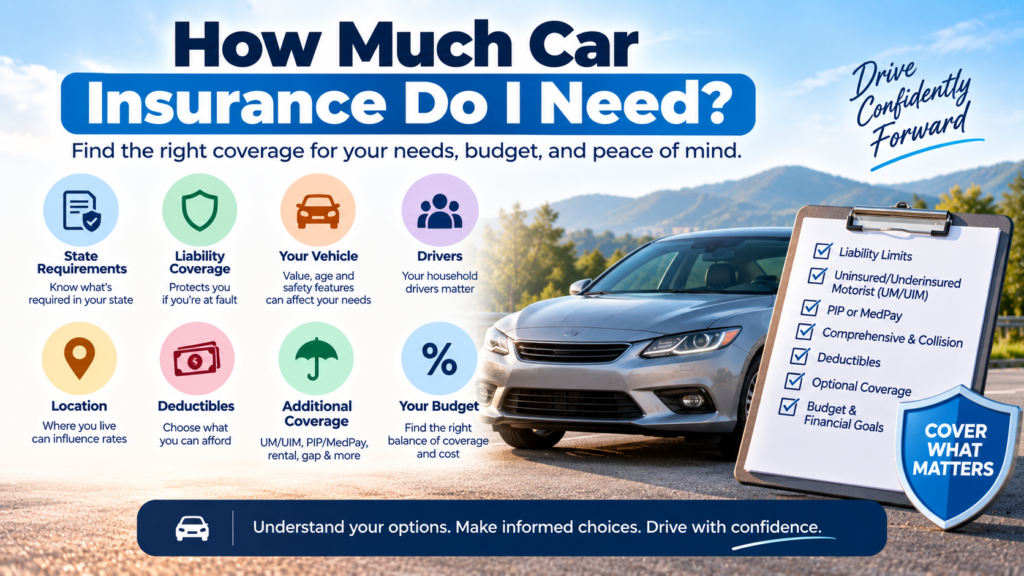
How Much Car Insurance Do I Need?
Choosing car insurance is not simply a matter of buying the cheapest policy or selecting the minimum amount required by your state.
The amount and types of car insurance you may need depend on several factors, including:
- Your state’s insurance requirements
- Your financial situation
- Your vehicle’s value
- Whether your vehicle is financed or leased
- How much liability risk you are comfortable accepting
- Your ability to pay for repairs or replace your vehicle
- The deductibles you could reasonably afford
- Other insurance coverage available to you
State-required minimum coverage provides a legal starting point, but the minimum required by law may not provide enough financial protection for every driver.
The goal is to understand what each coverage does and then choose limits and deductibles that make sense for your circumstances.
Start With Your State’s Minimum Car Insurance Requirements
Every state has its own auto insurance or financial-responsibility rules.
Depending on where you live, required coverage may include some combination of:
- Bodily injury liability
- Property damage liability
- Personal Injury Protection (PIP)
- Medical Payments coverage
- Uninsured motorist coverage
- Underinsured motorist coverage
Requirements and minimum limits vary considerably by state.
That means there is no single nationwide minimum car insurance policy that applies to every U.S. driver.
Before deciding how much insurance to buy, understand the current requirements in the state where your vehicle is registered and principally garaged.
Is State-Minimum Car Insurance Enough?
Not necessarily.
A state minimum establishes a legal requirement. It does not guarantee that the available coverage will be sufficient after a serious accident.
Consider a hypothetical accident in which you are legally responsible for substantial injuries to another person.
If an eligible liability claim exceeds your applicable policy limit, the insurance policy does not automatically provide unlimited protection.
Depending on the circumstances and applicable law, amounts beyond available insurance coverage could create significant financial exposure.
This is why liability limits deserve careful consideration even when higher limits increase your premium.
What Is Liability Insurance?
Auto liability insurance generally helps protect you financially when you are legally responsible for covered injuries or property damage suffered by other people.
The two primary components are:
- Bodily injury liability
- Property damage liability
Liability coverage generally does not pay to repair your own vehicle after an accident you cause.
Protection for your own vehicle generally involves coverages such as collision and comprehensive insurance.
How Much Bodily Injury Liability Do You Need?
Bodily injury liability generally helps address covered claims involving injuries you cause to other people.
Depending on the claim and policy, eligible costs can potentially include:
- Medical expenses
- Lost income
- Legal defense costs
- Other covered damages associated with bodily injury
The appropriate liability limit is not the same for every household.
When evaluating limits, consider your potential financial exposure rather than looking only at the minimum required by law.
Understanding Split Liability Limits
Liability insurance is often displayed using three numbers.
For example:
100/300/100
In a typical split-limit policy, this might mean:
- $100,000 bodily injury liability per person
- $300,000 bodily injury liability per accident
- $100,000 property damage liability per accident
This is only an example.
Your actual policy may use different limits or a different liability structure.
Always confirm exactly what the numbers on your quote and declarations page mean.
Example of Why Liability Limits Matter
Imagine a hypothetical covered accident for which you are legally responsible.
Suppose the eligible bodily injury damages for one injured person reach $150,000, while your applicable bodily injury liability limit per person is $100,000.
The existence of a $100,000 policy limit does not make the additional eligible damages disappear.
How amounts beyond insurance limits are handled depends on the facts, applicable law, available insurance, and other circumstances.
The example illustrates why the legal minimum and an appropriate personal liability limit are two different questions.
How Much Property Damage Liability Do You Need?
Property damage liability generally helps pay for covered damage you cause to someone else’s property.
That property can include:
- Another person’s vehicle
- Multiple vehicles
- Fences
- Buildings
- Guardrails
- Utility equipment
- Other structures or property
Modern vehicles can be expensive to repair or replace.
A serious accident can also damage more than one vehicle or piece of property.
For this reason, consider whether your selected property damage liability limit provides a level of protection you are comfortable with.
Should You Buy More Than State-Minimum Liability?
Many drivers may benefit from evaluating liability limits above the legal minimum.
Factors worth considering include:
- Savings
- Income
- Property
- Investments
- Other assets
- Potential future financial exposure
- Cost of increasing the limits
Higher limits generally cost more, but the premium difference may be smaller than you expect.
Rather than assuming higher liability coverage is unaffordable, compare actual quotes using several limit options.
How Assets Affect Your Liability Decision
One reason people purchase liability insurance is to transfer some financial risk associated with causing an accident to an insurer.
If you have assets or income you want to protect, very low liability limits may leave a larger portion of that risk with you.
However, choosing liability limits is not simply a mathematical calculation based on net worth.
Applicable state laws, personal circumstances, insurance contracts, and potential claims can be complex.
If you have substantial assets or unusual liability concerns, consider discussing your situation with a licensed insurance professional or qualified financial/legal professional as appropriate.
What Is a Combined Single Limit?
Not every auto policy uses split limits.
Some policies may offer a combined single limit, commonly called a CSL.
Instead of separate per-person bodily injury, per-accident bodily injury, and property damage limits, a combined single limit provides one overall liability limit for a covered accident, subject to the policy terms.
For example, a policy might provide a $500,000 combined single limit.
Do not assume that a CSL can be compared directly with split limits simply by looking at one number.
Review how each policy allocates liability protection.
Do You Need Uninsured Motorist Coverage?
Uninsured motorist coverage, commonly abbreviated UM, can provide protection in certain covered situations involving a driver who does not have applicable liability insurance.
Depending on the state and policy, uninsured motorist protection may address bodily injury and potentially certain property damage.
Requirements vary significantly by state.
Some jurisdictions require certain UM coverage, while others require insurers to offer it or permit policyholders to reject it under specified conditions.
What Is Underinsured Motorist Coverage?
Underinsured motorist coverage, commonly called UIM, can apply in certain covered situations when an at-fault driver has insurance but does not have enough applicable liability coverage to address the covered loss.
Imagine another driver causes a serious accident and has only limited bodily injury liability insurance.
If your eligible damages exceed that driver’s available liability coverage, applicable UIM protection may help, subject to your policy, limits, state law, and circumstances.
UM and UIM rules are particularly state-specific, so review the actual coverage available where you live.
How Much UM/UIM Coverage Should You Consider?
There is no single correct amount for every driver.
Consider:
- State requirements
- Available limits
- Your liability limits
- Health insurance
- Disability or income concerns
- Household members covered
- Potential medical costs
- Your ability to absorb an uninsured loss
Some states or insurers may restrict how UM/UIM limits relate to liability limits.
Review the actual options on your quote rather than assuming you can select any amount.
Do You Need Personal Injury Protection?
Personal Injury Protection, or PIP, is required in certain states and optional or unavailable in others.
Depending on state law and policy terms, PIP can help with certain expenses resulting from injuries after an auto accident.
These may include:
- Medical expenses
- Lost wages
- Rehabilitation expenses
- Certain other eligible costs
The exact benefits, limits, deductibles, and rules differ considerably by state.
If you live in a jurisdiction where PIP is required, make sure your policy satisfies the applicable requirements.
If optional choices are available, compare what the additional coverage provides.
What Is Medical Payments Coverage?
Medical Payments coverage, commonly called MedPay, can help pay certain eligible medical expenses for you and your passengers after a covered accident.
It is different from bodily injury liability.
Bodily injury liability generally concerns covered injuries you cause to other people.
MedPay is generally designed to address certain medical expenses for insured people regardless of fault, subject to policy terms and state rules.
Availability and limits vary.
Do You Need Collision Coverage?
Collision coverage generally helps repair or replace your insured vehicle after certain covered collision-related losses, subject to the deductible and policy terms.
Examples can include collisions with:
- Another vehicle
- A tree
- A guardrail
- A pole
- Another object
Collision can also cover certain rollover losses.
States generally do not require collision coverage simply to drive.
However, a lender or leasing company may require it when a vehicle is financed or leased.
How Much Collision Coverage Should You Buy?
Collision insurance works differently from liability coverage.
You generally do not select a liability-style dollar limit such as $100,000 or $300,000 for collision.
Instead, the amount available for a covered vehicle loss is generally tied to the insured vehicle and the terms of the policy, including its value and deductible.
Your main choices often involve:
- Whether to carry collision
- What deductible to choose
This is why deciding whether you need collision often depends heavily on the vehicle’s value and your financial ability to repair or replace it.
Do You Need Comprehensive Coverage?
Comprehensive coverage generally protects your insured vehicle against certain covered losses other than collisions.
Depending on the policy, examples may include:
- Theft
- Vandalism
- Fire
- Hail
- Windstorm
- Flood-related vehicle damage
- Falling objects
- Animal impacts
- Certain glass damage
Like collision, comprehensive generally has a deductible.
It is typically not required by state law simply to operate a vehicle, but lenders and leasing companies may require it.
How Much Comprehensive Coverage Do You Need?
As with collision, comprehensive generally does not involve selecting a liability-style coverage limit.
The coverage applies to the insured vehicle according to its value, deductible, policy terms, and claim circumstances.
Your decision is therefore often about:
- Whether comprehensive is worth carrying
- Which deductible to select
- Whether your lender requires it
- Whether you could absorb the loss of the vehicle yourself
Do You Need Both Comprehensive and Collision?
Not necessarily in every situation.
Comprehensive and collision protect against different types of vehicle losses.
Collision focuses primarily on collision-related damage.
Comprehensive focuses primarily on specified non-collision risks.
A driver may value one differently from the other depending on:
- Vehicle value
- Premium
- Deductibles
- Local risks
- Financial circumstances
- Lender requirements
If your vehicle is financed or leased, you may be required to maintain both.
What Does “Full Coverage” Mean?
“Full coverage” is an informal term rather than a standardized insurance policy.
It commonly refers to a policy containing:
- Liability coverage
- Collision coverage
- Comprehensive coverage
The policy may also contain other required or optional coverage.
Full coverage does not mean every possible loss is insured.
Policies still have:
- Limits
- Deductibles
- Exclusions
- Conditions
- Definitions
Always review the actual coverage instead of relying on the phrase “full coverage.”
Do You Need Full Coverage on a Financed Car?
If your vehicle is financed, your lender will commonly require comprehensive and collision coverage in addition to legally required insurance.
The lender has a financial interest in the vehicle until the loan is repaid.
A leased vehicle may have similar requirements established by the leasing company.
Your financing or lease agreement can also impose requirements beyond state minimum insurance laws.
Do not remove required physical-damage coverage without reviewing the agreement.
Do You Need Full Coverage on a Paid-Off Car?
Once you own the vehicle outright, there is generally no auto lender requiring you to maintain collision and comprehensive coverage.
That does not automatically mean you should remove them.
Ask:
- What is the vehicle worth?
- How much do collision and comprehensive cost?
- What deductibles apply?
- Could I pay for major repairs myself?
- Could I replace the vehicle if it were totaled?
- How important is the vehicle to my daily life?
A paid-off vehicle can still represent a substantial financial asset.
When Might Liability-Only Coverage Be Reasonable?
Some owners of older or lower-value vehicles may decide not to purchase collision and comprehensive coverage.
That decision may be worth evaluating when:
- The vehicle is owned outright
- Its market value is relatively low
- Physical-damage premiums are significant relative to its value
- Deductibles reduce the potential benefit
- The owner could financially replace the vehicle
There is no universal vehicle age at which every driver should switch to liability-only coverage.
Example: Evaluating Coverage on an Older Vehicle
Suppose a paid-off vehicle has a relatively modest market value.
The owner reviews:
- Annual collision premium
- Annual comprehensive premium
- Collision deductible
- Comprehensive deductible
- Current vehicle value
The owner then asks:
If this car were totaled tomorrow and insurance did not pay for my vehicle, could I comfortably replace it?
If the answer is no, maintaining physical-damage coverage may still have meaningful value.
If the answer is yes, the owner may evaluate whether continuing the coverage is worth its cost.
The decision depends on individual circumstances.
Choosing a Collision Deductible
Collision deductibles commonly come in several amounts.
Examples might include:
- $250
- $500
- $1,000
- $1,500
Available options vary by insurer.
A higher deductible generally lowers the premium because you are agreeing to absorb more of an applicable covered loss yourself.
But a deductible should not be selected solely for premium savings.
Choosing a Comprehensive Deductible
Comprehensive deductibles may also be available at different levels.
The same basic principle applies:
Higher deductible → generally lower premium → more financial responsibility for you after an applicable claim.
Comprehensive and collision do not necessarily have to use identical deductibles if the insurer offers different options.
Compare the cost of each option.
How Much Deductible Can You Afford?
A useful question is not:
What is the highest deductible available?
Instead ask:
How much could I comfortably pay tomorrow if an unexpected covered loss occurred?
Suppose you select a $1,500 collision deductible to save on premiums.
If paying $1,500 unexpectedly would create a serious financial problem, the premium savings may not justify the additional risk.
Choose a deductible that fits both your budget today and your ability to handle a claim later.
Do You Need Gap Insurance?
Gap-related protection may be worth considering when you finance or lease a vehicle and could owe more than the vehicle’s covered value.
Comprehensive and collision generally protect the vehicle based on the applicable claim valuation and policy terms.
They do not automatically guarantee payment of the entire remaining loan balance.
Because vehicles can depreciate quickly, a difference may exist between:
- Covered vehicle settlement
- Remaining loan or lease obligation
Gap products may help address an eligible difference, subject to their specific terms.
Who May Want to Consider Gap Coverage?
Gap-related protection may deserve consideration when:
- You made a small down payment
- Your loan term is long
- The vehicle depreciates quickly
- Your loan balance is substantially higher than the vehicle’s current value
- Your lease requires or includes gap-related protection
Do not purchase duplicate coverage without first checking your financing or lease documents.
Some agreements may already include certain gap protection.
Do You Need Rental Reimbursement Coverage?
Rental reimbursement is generally optional.
It can help with certain rental transportation expenses when your insured vehicle cannot be used because of an eligible covered loss.
Coverage may have:
- Daily limits
- Total limits
- Time limits
- Eligibility requirements
Consider how you would manage transportation while your vehicle is being repaired after a covered claim.
If you have another household vehicle or could easily manage without a rental, the coverage may be less important to you.
Do You Need Roadside Assistance?
Roadside assistance can provide services such as:
- Towing
- Battery assistance
- Flat-tire service
- Lockout assistance
- Fuel delivery
Benefits vary by provider.
Before adding it to your auto policy, check whether you already receive similar benefits through:
- Vehicle manufacturer
- Auto club
- Credit card
- New-car warranty
- Another membership
Avoid paying for unnecessary duplicate services.
What About Custom Equipment?
Standard auto policies may place restrictions on aftermarket equipment or custom modifications.
Examples can include:
- Custom wheels
- Specialized audio systems
- Performance modifications
- Custom paint
- Accessibility equipment
- Other aftermarket equipment
If your vehicle has expensive modifications, ask the insurer how they are covered.
You may need an endorsement or additional coverage.
Do You Need Rideshare Coverage?
Personal auto insurance may not provide the same protection when a vehicle is being used for rideshare or certain commercial activities.
If you drive for a rideshare or delivery platform, determine:
- What your personal policy covers
- What the platform provides
- When each policy applies
- Whether a coverage gap exists
- Whether a rideshare endorsement is available
Do not assume a normal personal auto policy automatically covers every commercial or app-based use.
Do You Need an Umbrella Policy?
A personal umbrella or excess liability policy can provide an additional layer of liability protection above certain underlying insurance policies.
For example, an umbrella policy may sit above:
- Auto liability insurance
- Homeowners liability insurance
- Other qualifying personal liability coverage
It generally begins providing applicable coverage after underlying liability limits are exhausted, subject to the umbrella policy’s terms.
Who Might Consider Umbrella Liability Coverage?
Umbrella coverage may be worth investigating if you have substantial financial exposure or want additional liability protection.
Factors can include:
- Assets
- Savings
- Income
- Property ownership
- Household drivers
- Certain lifestyle-related liability risks
Umbrella insurers typically require specified underlying auto and homeowners liability limits.
Ask what underlying limits are required before purchasing the policy.
How Much Car Insurance Does a Family Need?
A household policy can be more complicated than insurance for one driver and one vehicle.
Consider:
- Number of drivers
- Teen or newly licensed drivers
- Number of vehicles
- Vehicle values
- Driving frequency
- Household assets
- Coverage needs
- Available discounts
A household with several drivers and significant assets may evaluate liability risk differently from a single driver with different financial circumstances.
There is no one family coverage amount appropriate for everyone.
How Much Car Insurance Does a Teen Driver Need?
A teen driver does not necessarily need lower liability protection simply because the driver is young.
Adding a newly licensed driver can increase both accident exposure and insurance cost.
When adding a teen, review:
- Liability limits
- Vehicle assignment
- Physical-damage coverage
- Deductibles
- UM/UIM coverage
- Eligible good-student discounts
- Driver-training discounts
- Telematics options and their terms
Do not reduce important coverage automatically just because the premium increased.
How Much Insurance Do You Need on a New Car?
A new vehicle often has substantial value.
If financed or leased, comprehensive and collision will commonly be required.
You may also want to evaluate:
- Deductibles
- Gap-related protection
- New-car replacement endorsements, if offered
- Rental reimbursement
- Liability limits
- UM/UIM
- Other state-required coverage
Do not assume that buying an expensive vehicle automatically increases every coverage limit.
Liability limits and vehicle physical-damage coverage protect against different risks.
How Much Insurance Do You Need on an Older Car?
For an older paid-off vehicle, review the economics of comprehensive and collision.
Consider:
- Market value
- Cost of each coverage
- Deductible
- Replacement ability
- Dependence on the vehicle
- Local comprehensive risks such as theft or severe weather
Liability coverage remains important even when your own vehicle has little value.
The value of your car does not determine the potential cost of injuries or property damage you could cause to someone else.
Do You Need Higher Liability Limits If You Drive an Older Car?
Potentially.
The value of your own car and your liability exposure are separate issues.
You could drive a low-value vehicle and still cause a serious accident involving:
- Expensive vehicles
- Multiple vehicles
- Significant injuries
- Property damage
Therefore, dropping comprehensive or collision on an older vehicle does not automatically mean reducing liability limits makes sense.
Evaluate each coverage independently.
How Much Car Insurance Do High-Income Drivers Need?
Income alone does not determine the correct insurance limits.
However, drivers with substantial assets or financial exposure may want to evaluate higher liability limits and potentially umbrella coverage.
The purpose is not to insure your car for the value of your assets.
Rather, higher liability coverage can provide a larger layer of protection against eligible claims made against you.
Individual legal and financial circumstances differ, so professional advice may be appropriate for complex situations.
How Much Car Insurance Do Low-Mileage Drivers Need?
Driving fewer miles may reduce exposure to accidents and can affect pricing with some insurers.
However, low mileage does not eliminate the need for adequate coverage.
A serious accident can occur even if you drive infrequently.
Your liability needs, vehicle value, state requirements, and financial situation still matter.
Low-mileage drivers can investigate:
- Low-mileage discounts
- Usage-based insurance
- Telematics programs
- Pay-per-mile options where available
Read the terms carefully before enrolling.
Should Your Liability Limits Match Your Net Worth?
There is no simple nationwide rule requiring your auto liability limit to equal your net worth.
Net worth can be one factor when considering financial exposure, but insurance decisions also involve:
- State law
- Income
- Assets
- Potential claim severity
- Policy availability
- Premium cost
- Other liability insurance
- Personal risk tolerance
Avoid treating a single formula as personalized financial or legal advice.
Should You Buy the Maximum Car Insurance Available?
Not necessarily.
More insurance generally provides more potential protection, but it also costs more.
The goal is not automatically to purchase every available coverage at the highest possible limit.
Instead, identify:
- What coverage is legally required.
- What coverage is contractually required by a lender or lessor.
- What losses could create serious financial hardship.
- Which risks you can reasonably retain yourself.
- What premium you can sustainably afford.
This produces a more thoughtful coverage decision.
What Happens If You Buy Too Little Car Insurance?
Insufficient coverage can create financial exposure after a serious loss.
Possible situations include:
- Liability damages exceeding policy limits
- No collision coverage for your damaged vehicle
- No comprehensive coverage after theft or weather damage
- High out-of-pocket medical or transportation expenses
- Insufficient protection involving an uninsured driver
Insurance cannot eliminate every financial risk, but appropriate coverage can transfer selected risks to the insurer.
Can You Have Too Much Car Insurance?
It is possible to purchase coverage that provides limited additional practical value relative to its cost.
For example, continuing expensive collision coverage on a very low-value paid-off vehicle may deserve review.
Likewise, paying for duplicate roadside benefits may not make sense.
But do not confuse unnecessary duplication with adequate liability protection.
Evaluate each coverage separately.
A Practical Step-by-Step Way to Choose Car Insurance
For a broader overview of coverage types and policy basics, see our auto insurance guide before comparing your options.
Instead of guessing at a single dollar amount, work through the policy systematically.
Step 1: Check State Requirements
Identify required coverage and minimum limits.
Step 2: Check Loan or Lease Requirements
If the vehicle is financed or leased, determine what physical-damage coverage and deductibles are required.
Step 3: Evaluate Liability Limits
Consider whether state minimum limits provide enough protection for your financial circumstances.
Step 4: Review UM/UIM
Understand what uninsured and underinsured motorist coverage is required or available in your state.
Step 5: Review PIP or MedPay
Determine whether either coverage is required and what optional limits are available.
Step 6: Decide on Collision
Consider vehicle value, premium, deductible, lender requirements, and your ability to replace the vehicle.
Step 7: Decide on Comprehensive
Evaluate theft, weather, vandalism, animal-related risks, premium, deductible, and vehicle value.
Step 8: Choose Affordable Deductibles
Select deductibles you could realistically pay after an unexpected claim.
Step 9: Evaluate Optional Coverage
Consider gap, rental reimbursement, roadside assistance, rideshare protection, and other relevant options.
Step 10: Compare Equivalent Quotes
Use the same limits, deductibles, drivers, vehicles, and optional coverage when comparing insurers.
Example of Comparing Three Coverage Levels
Suppose a driver requests three hypothetical quotes.
Option A: Minimum-Focused Policy
Contains:
- State-required liability limits
- Other state-required coverage
- No comprehensive
- No collision
This may produce the lowest premium but also leaves more financial risk with the driver.
Option B: Broader Policy
Contains:
- Higher liability limits
- Required coverage
- UM/UIM where selected
- Comprehensive
- Collision
- Moderate deductibles
The premium will generally be higher, but the policy transfers more types of covered risk to the insurer.
Option C: Higher-Protection Policy
Contains:
- Higher liability limits
- Comprehensive
- Collision
- Selected UM/UIM
- Other appropriate optional coverage
- Potential umbrella protection
This structure may provide greater protection but also costs more.
The purpose of comparing the options is not to assume Option C is automatically best.
It is to understand exactly what additional protection you receive for the additional premium.
Compare the Same Coverage Across Insurance Companies
One of the biggest mistakes when shopping for insurance is comparing policies with different coverage.
For example:
Quote A
- Lower liability limits
- $1,000 collision deductible
- No rental reimbursement
Quote B
- Higher liability limits
- $500 collision deductible
- Rental reimbursement
If Quote A is cheaper, that does not necessarily mean the insurer offers a better price for the same insurance.
The policies are different.
For a meaningful comparison, keep major coverage selections consistent.
Read Your Declarations Page
Your declarations page provides a useful summary of your current auto insurance policy.
It may show:
- Covered drivers
- Covered vehicles
- Policy dates
- Liability limits
- UM/UIM limits
- PIP or MedPay
- Comprehensive coverage
- Collision coverage
- Deductibles
- Endorsements
- Premium information
Review it at renewal and after significant changes.
Do not assume your coverage remains appropriate simply because you have carried the same policy for years.
When Should You Review Your Car Insurance Coverage?
Consider reviewing your coverage when:
- Your policy renews
- You buy another vehicle
- You finance or lease a vehicle
- You pay off your car loan
- You move
- You add a driver
- A teenager begins driving
- Your financial circumstances change materially
- You begin rideshare or delivery work
- Your vehicle’s value changes significantly
- Your premium changes substantially
A policy that made sense several years ago may not fit your current situation.
Questions to Ask Before Buying Car Insurance
Before purchasing a policy, consider asking:
- What coverage does my state require?
- What limits are required?
- Do I need PIP or MedPay?
- Is UM/UIM required or optional?
- What liability limits are available?
- What do higher liability limits cost?
- What comprehensive deductibles are available?
- What collision deductibles are available?
- Does my lender require specific coverage?
- Is gap protection included or separate?
- Is rental reimbursement included?
- Is roadside assistance included?
- What discounts apply?
- What important exclusions should I understand?
The answers can make policy comparisons much clearer.
Common Mistakes When Choosing How Much Car Insurance to Buy
Buying Only the Legal Minimum Without Evaluating the Risk
Legal minimums and adequate personal protection are not necessarily the same thing.
Choosing Limits Based Only on Premium
Lower limits transfer less liability risk to the insurer.
Ignoring UM/UIM Coverage
Another driver’s lack of adequate insurance can create financial consequences for you.
Dropping Comprehensive and Collision on a Financed Vehicle
Doing so may violate loan or lease requirements.
Selecting a Deductible You Cannot Afford
A deductible should be manageable after an unexpected loss.
Assuming “Full Coverage” Means Everything Is Covered
It does not.
Forgetting About Vehicle Value
Physical-damage coverage on an older paid-off vehicle should be evaluated relative to its cost and the vehicle’s value.
Comparing Different Coverage Levels
A cheaper quote is not necessarily cheaper insurance if it provides less coverage.
Never Reviewing the Policy
Coverage needs can change over time.
Frequently Asked Questions
How much car insurance do I legally need?
The answer depends on your state. States establish their own insurance and financial-responsibility requirements, and required coverage and minimum limits vary.
Is minimum car insurance enough?
It satisfies applicable minimum legal requirements when properly structured, but it may not provide enough financial protection for every driver or every serious accident.
How much liability car insurance should I have?
There is no single limit appropriate for everyone. Consider your financial exposure, assets, income, available limits, premium differences, and state requirements.
Do I need 100/300 liability coverage?
100/300 is one commonly discussed split-limit structure, but it is not a universal requirement or automatically appropriate for every driver. Compare available limits based on your circumstances.
What does 100/300/100 insurance mean?
In a typical split-limit structure, it generally represents $100,000 bodily injury liability per person, $300,000 bodily injury liability per accident, and $100,000 property damage liability per accident. Confirm how your insurer defines the limits.
Do I need collision insurance?
Collision may be required by a lender or lessor. For an owned vehicle, consider its value, the cost of coverage, deductible, and your ability to repair or replace it yourself.
Do I need comprehensive insurance?
Comprehensive may be worthwhile if losses such as theft, hail, fire, vandalism, falling objects, or animal impacts would create significant financial difficulty. Lenders may also require it.
Do I need full coverage?
There is no universal requirement to purchase what is commonly called full coverage once lender requirements do not apply. Consider vehicle value, finances, premiums, deductibles, and your ability to absorb a loss.
Do I need full coverage if my car is paid off?
A lender generally will no longer be requiring physical-damage coverage after the applicable loan is fully paid, but comprehensive and collision may still be valuable depending on the vehicle and your finances.
What deductible should I choose?
Choose a deductible you could realistically pay after an unexpected covered claim. Higher deductibles generally reduce premiums but increase your share of an applicable loss.
Do I need uninsured motorist coverage?
Requirements vary by state. Even where optional, consider what financial risk an uninsured or underinsured at-fault driver could create for you.
Do I need gap insurance?
It may be useful when the amount owed on a financed or leased vehicle could exceed the applicable covered vehicle settlement. Check whether your financing or lease agreement already provides gap-related protection.
Is umbrella insurance part of car insurance?
An umbrella policy is generally a separate excess liability policy that can provide additional protection above qualifying underlying policies, including auto liability insurance.
Should I reduce coverage to save money?
You can review deductibles and optional coverage, but understand the financial risk before reducing protection. A lower premium is not automatically a better financial outcome.
The Bottom Line
There is no single amount of car insurance that is right for every U.S. driver.
Your appropriate coverage depends on a combination of:
- State requirements
- Loan or lease requirements
- Liability exposure
- Assets and financial circumstances
- Vehicle value
- Ability to repair or replace your vehicle
- Available UM/UIM protection
- PIP or MedPay requirements
- Deductibles
- Optional coverage needs
- Budget
Start with what your state requires, but do not automatically stop there.
Consider whether your liability limits provide a level of financial protection you are comfortable with.
Then decide whether comprehensive and collision make sense based on your vehicle, financing situation, and ability to absorb a loss.
Choose deductibles you could realistically pay.
Finally, compare quotes using the same coverage limits and deductibles so that price differences actually mean something.
The best car insurance decision is not necessarily the policy with the lowest premium or the greatest number of coverages.
It is a policy that provides an appropriate balance between legal requirements, financial protection, vehicle protection, deductibles, and a premium you can reasonably maintain.