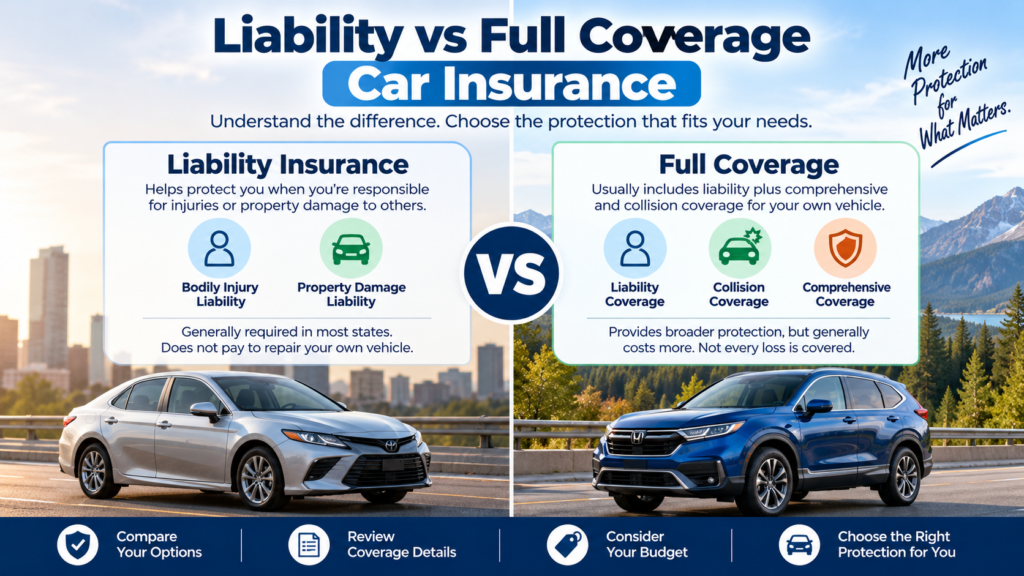
When shopping for car insurance, you will often hear two phrases: liability insurance and full coverage car insurance.
They may sound like two simple policy choices, but the difference is important.
Liability insurance generally helps protect you financially when you are legally responsible for covered injuries or property damage to other people.
“Full coverage,” on the other hand, is an informal term commonly used for a policy that combines liability insurance with collision and comprehensive coverage for your own vehicle.
However, full coverage does not mean that every accident, expense, or loss is covered.
Understanding the difference can help you choose appropriate coverage, compare insurance quotes more accurately, and avoid buying a policy based only on price.
What Is Liability Car Insurance?
Liability insurance generally helps pay for covered losses involving other people when you are legally responsible for an auto accident.
Auto liability insurance commonly includes two major components:
- Bodily injury liability
- Property damage liability
Most states require drivers to maintain some form of financial responsibility, commonly through auto liability insurance, although exact requirements differ by state.
Liability coverage generally does not pay to repair your own vehicle after an accident you cause.
That distinction is one of the biggest differences between liability-only coverage and what consumers commonly call full coverage.
What Is Bodily Injury Liability?
Bodily injury liability generally helps cover qualifying costs when another person is injured in an accident for which you are legally responsible.
Depending on the circumstances and policy, covered losses may include things such as:
- Medical expenses
- Lost wages
- Legal defense costs
- Other covered damages resulting from bodily injury
Coverage applies only up to the limits and according to the terms of your policy.
If a covered liability claim exceeds your available insurance limits, the policy does not automatically provide unlimited protection.
That is one reason choosing liability limits deserves careful consideration.
What Is Property Damage Liability?
Property damage liability generally helps pay for covered damage you cause to someone else’s property.
The most common example is damage to another person’s vehicle.
However, covered property damage can potentially involve other property such as:
- Fences
- Buildings
- Guardrails
- Utility equipment
- Other structures or objects
Property damage liability generally does not pay to repair your own vehicle.
Coverage for your own vehicle is usually handled through other parts of an auto policy, such as collision or comprehensive coverage.
Understanding Liability Limits
Auto liability limits are often displayed using numbers such as:
100/300/100
In a typical split-limit policy, this could represent:
- $100,000 bodily injury liability per person
- $300,000 bodily injury liability per accident
- $100,000 property damage liability per accident
These numbers are examples only.
Actual available limits and state requirements vary.
Always confirm how the limits on your quote or declarations page are defined.
Is State-Minimum Liability Coverage Enough?
State minimum liability requirements establish the minimum coverage required under applicable law in certain circumstances.
They do not necessarily represent the amount of financial protection that is appropriate for every driver.
Consider a hypothetical situation in which you cause an accident resulting in significant injuries or damage to an expensive vehicle.
If the covered losses exceed your applicable liability limits, your available insurance coverage may not be enough to address the entire claim.
The consequences depend on the facts, applicable law, policy terms, and other available insurance.
When choosing limits, consider more than simply the lowest premium.
What Does “Liability-Only Insurance” Mean?
The phrase liability-only insurance generally describes a policy that provides required or selected liability protection without comprehensive and collision coverage for your own vehicle.
Depending on the state, the policy may also contain other required coverage.
For example, applicable law might require or affect coverage such as:
- Uninsured motorist coverage
- Underinsured motorist coverage
- Personal Injury Protection
- Medical Payments coverage
Therefore, “liability only” does not necessarily mean that liability is literally the only coverage listed on the policy.
The actual policy depends on state requirements and the coverages selected.
What Is Full Coverage Car Insurance?
“Full coverage” is a commonly used phrase, but it is not a standardized insurance policy that protects against every possible event.
Consumers often use the term to describe a policy containing:
- Liability coverage
- Collision coverage
- Comprehensive coverage
Depending on the policy, it may also include required or optional coverages such as uninsured motorist protection, underinsured motorist protection, PIP, MedPay, rental reimbursement, or roadside assistance.
The important point is that full coverage does not mean unlimited coverage.
Every policy has defined coverages, limits, deductibles, conditions, and exclusions.
Liability vs Full Coverage at a Glance
The main difference is what property and losses the policy is designed to protect.
Liability-Only Coverage
Generally focuses on covered injuries or property damage you cause to other people.
Full Coverage
Commonly combines liability protection with comprehensive and collision coverage designed to help protect your own vehicle against certain covered losses.
This additional vehicle protection is why full coverage generally costs more than liability-only coverage when other factors remain similar.
What Is Collision Coverage?
Collision coverage generally helps pay for covered physical damage to your own vehicle resulting from a collision.
Examples may include hitting:
- Another vehicle
- A tree
- A pole
- A guardrail
- Another object
Collision coverage can also apply to certain rollover accidents, subject to policy terms.
Unlike liability coverage, collision coverage is focused on damage to your insured vehicle.
Collision Coverage Example
Suppose you accidentally lose control of your vehicle and hit a guardrail.
Your vehicle suffers $6,000 of covered collision damage.
Assume your collision deductible is $500.
In a simplified example, you might be responsible for the $500 deductible and the collision coverage could address the remaining eligible repair cost, subject to the policy terms, vehicle value, claim handling, and applicable limits.
If you carried liability-only insurance without collision coverage, your liability coverage generally would not pay to repair your own car merely because you caused the accident.
What Is Comprehensive Coverage?
Comprehensive coverage generally helps pay for certain covered damage to your vehicle caused by events other than a collision.
Depending on the policy, examples may include:
- Theft
- Vandalism
- Fire
- Hail
- Windstorms
- Falling objects
- Flood-related vehicle damage
- Animal impacts
- Certain glass damage
Comprehensive coverage is sometimes described in policy documents as coverage for losses “other than collision.”
Like collision coverage, comprehensive insurance usually has a deductible.
Comprehensive Coverage Example
Imagine your vehicle is parked outside during a severe storm and large hailstones damage the body and windows.
Liability insurance generally would not cover that damage to your own vehicle.
If the event is covered under your comprehensive coverage, the policy may help pay eligible repair costs after the applicable deductible, subject to policy terms.
Liability vs Collision vs Comprehensive
These three coverages address different risks.
Liability
Generally helps with covered injuries or property damage you cause to others.
Collision
Generally helps repair or replace your own covered vehicle after a collision-related loss.
Comprehensive
Generally helps with specified covered damage to your own vehicle from non-collision events such as theft, vandalism, fire, severe weather, or animal-related damage.
Understanding these distinctions makes the phrase “full coverage” easier to understand.
What Does Full Coverage Not Cover?
The phrase “full coverage” can create the false impression that every possible expense is insured.
That is not the case.
Depending on your policy, circumstances, and exclusions, a standard auto policy may not cover certain losses or may require separate optional coverage.
Examples can include:
- Routine maintenance
- Normal wear and tear
- Mechanical breakdown unrelated to a covered loss
- Personal belongings stolen from the vehicle under ordinary auto physical-damage coverage
- Certain commercial or delivery use
- Losses above policy limits
- Certain excluded drivers or uses
- Other specifically excluded circumstances
Coverage varies by insurer and policy.
Read your policy rather than relying on the phrase “full coverage.”
Does Full Coverage Include Rental Car Reimbursement?
Not automatically.
Rental reimbursement is often an optional coverage.
It can help pay certain rental transportation expenses when your insured vehicle cannot be used because of an eligible covered loss.
Policies commonly place limits on:
- Amount paid per day
- Maximum total benefit
- Number of days
- Circumstances under which coverage applies
If rental transportation would be important to you after a covered claim, verify whether it appears on your policy.
Does Full Coverage Include Roadside Assistance?
Not necessarily.
Roadside assistance may be offered as optional coverage or as a separate service.
Depending on the program, services might include:
- Towing
- Battery assistance
- Flat-tire assistance
- Lockout service
- Fuel delivery
Benefits and restrictions vary.
Some drivers may already have roadside benefits through another membership, vehicle manufacturer, credit card, or other program, so review existing benefits before paying for duplicate services.
Does Full Coverage Include Gap Insurance?
Not automatically.
Gap-related protection is separate from standard comprehensive and collision coverage.
A vehicle can lose value faster than a loan balance declines.
If a financed vehicle is declared a total loss, there can sometimes be a difference between the covered vehicle settlement and the amount still owed on the loan or lease.
Certain gap products may help address an eligible difference, subject to their terms.
Gap coverage may be available through an insurer, lender, dealer, or another provider.
Do not assume it is included simply because you purchased “full coverage.”
What Deductibles Apply to Full Coverage?
Comprehensive and collision coverage commonly have deductibles.
Possible deductible choices might include:
- $250
- $500
- $1,000
- $1,500
Available options vary.
A higher deductible will often reduce the premium, all else being equal, but it also increases the amount you must absorb when an applicable covered claim occurs.
Liability coverage generally works differently and ordinarily does not use the same type of deductible as collision or comprehensive coverage in a standard personal auto policy.
Review your quote carefully.
Example: $500 vs $1,000 Deductible
Suppose two otherwise similar policies offer collision coverage.
Policy A has a:
$500 collision deductible
Policy B has a:
$1,000 collision deductible
Policy B may have a lower premium.
But after an eligible collision claim, you would generally be responsible for more of the covered loss before insurance payments under that coverage.
The appropriate choice depends partly on whether the premium savings are worth assuming the additional financial risk.
Which Costs More: Liability or Full Coverage?
All else being equal, a policy containing liability, collision, and comprehensive coverage will generally cost more than a comparable policy without collision and comprehensive.
That makes sense because the insurer is taking on additional types of risk.
However, there is no single universal price difference between liability-only and full coverage.
Premiums depend on many factors, which may include:
- State
- Location
- Driving history
- Vehicle
- Driver characteristics
- Coverage limits
- Deductibles
- Annual mileage
- Discounts
- Other rating factors permitted by state law
The best way to understand the price difference for your circumstances is to compare quotes using consistent information.
Before comparing policies, review our auto insurance guide to better understand common coverage options and how they work.
When Is Full Coverage Required?
State law generally does not require drivers to purchase comprehensive and collision coverage simply to operate a personally owned vehicle.
However, if your car is financed or leased, your lender or leasing company may require comprehensive and collision coverage.
The vehicle serves as collateral for the loan or is owned by the leasing company, so the company has an interest in protecting it against physical damage.
Always check your finance or lease agreement.
What Happens If You Drop Full Coverage on a Financed Car?
If comprehensive or collision coverage is required by your loan or lease agreement and you remove it, you may violate the agreement.
The lender may take actions permitted under the contract and applicable law.
In some circumstances, a lender may purchase insurance designed primarily to protect its financial interest and charge the cost to the borrower.
Such coverage may be expensive and may not provide the same protection as a normal personal auto policy.
Therefore, do not remove required coverage from a financed or leased vehicle without understanding your contractual obligations.
When Might Liability-Only Coverage Make Sense?
Liability-only coverage may be considered by some drivers who own an older or lower-value vehicle outright.
For example, suppose:
- The vehicle has relatively low market value
- There is no lender requiring physical-damage coverage
- Comprehensive and collision premiums have become significant relative to the vehicle’s value
- The owner could financially manage repairing or replacing the vehicle without insurance
In that situation, the owner may evaluate whether continuing comprehensive and collision provides enough value.
There is no universal age or dollar value at which every driver should drop these coverages.
When Might Full Coverage Make Sense?
Keeping comprehensive and collision protection may be particularly worth considering when:
- Your lender or lessor requires it
- Your vehicle has substantial value
- Replacing your vehicle yourself would create financial hardship
- You rely heavily on your vehicle
- You want protection against certain theft, weather, collision, or vandalism losses
- The cost of coverage is reasonable relative to the protection provided
Your financial ability to absorb a major vehicle loss matters.
How to Decide Whether to Drop Collision Coverage
If your vehicle is paid off, consider several questions before removing collision coverage.
What Is the Vehicle Worth?
Research a reasonable current vehicle value.
How Much Does Collision Coverage Cost?
Look at the collision portion of your premium rather than assuming the entire policy premium relates to collision.
What Is Your Deductible?
A high deductible reduces the amount of potential insurance benefit on a lower-value vehicle.
Could You Replace the Car Yourself?
If your car were totaled tomorrow, could you purchase replacement transportation without serious financial strain?
Do You Depend on the Vehicle?
A vehicle that is essential for commuting or family responsibilities may have practical value beyond its market price.
These questions can help you evaluate the trade-off.
Should You Drop Comprehensive but Keep Collision?
You do not necessarily have to make the same decision about comprehensive and collision coverage.
Some drivers may find one coverage more valuable relative to its price.
For example, comprehensive can protect against risks such as theft, hail, vandalism, or animal damage.
The cost of comprehensive may also differ materially from collision coverage.
Instead of treating the two as an inseparable package, review:
- Individual premium cost
- Deductible
- Vehicle value
- Local risks
- Your ability to absorb a loss
- Lender requirements
Ask your insurer what each coverage costs before deciding.
Full Coverage on an Older Car
An older vehicle does not automatically mean you should purchase liability-only insurance.
Vehicle age is only one factor.
An older car might still have enough value that replacing it would be difficult for the owner.
Likewise, a relatively new vehicle might be owned outright by someone who can comfortably self-insure physical damage.
A better question is:
What would happen financially if this vehicle were badly damaged or totaled tomorrow?
The answer can help you evaluate whether comprehensive and collision are valuable to you.
What Happens If Your Car Is Totaled?
When an insurer determines that a covered vehicle is a total loss, settlement typically depends on the applicable coverage, policy terms, vehicle value determination, deductible, state requirements, and claim circumstances.
Full coverage does not guarantee that you will receive:
- The amount you originally paid for the vehicle
- The remaining amount of your auto loan
- Enough money to buy a brand-new equivalent vehicle
Those are different concepts.
This is another reason financed vehicle owners should understand both physical-damage insurance and any applicable gap-related protection.
Does Liability Cover Your Own Injuries?
Liability coverage is primarily designed around liability for injuries or property damage to others.
Coverage for your own injuries or those of your passengers may involve other parts of an auto policy or other insurance.
Depending on state law and policy terms, relevant coverage might include:
- Personal Injury Protection
- Medical Payments coverage
- Uninsured motorist coverage
- Underinsured motorist coverage
- Health insurance
- Other applicable insurance
The exact interaction varies by jurisdiction and circumstances.
Uninsured and Underinsured Motorist Coverage
Uninsured motorist coverage can provide protection in certain covered circumstances when an at-fault driver does not have applicable insurance.
Underinsured motorist coverage can apply in certain situations when the responsible driver has insurance but does not have enough applicable liability coverage to address covered losses.
Requirements and availability vary significantly by state.
Some states require certain uninsured or underinsured motorist coverage or require insurers to offer it, while other rules apply elsewhere.
Do not assume a liability or full-coverage quote treats this coverage the same way.
PIP and Medical Payments Coverage
Some auto policies include or offer Personal Injury Protection, commonly called PIP, or Medical Payments coverage, often called MedPay.
These coverages can help address certain eligible medical costs after an accident.
PIP may also provide certain additional benefits depending on applicable state law and policy terms.
Requirements differ considerably by state.
When comparing liability-only and full-coverage quotes, check these coverages separately rather than assuming they are part of collision or comprehensive insurance.
Liability Coverage Still Matters With Full Coverage
A common mistake is focusing on comprehensive and collision while ignoring liability limits.
The fact that a policy includes physical-damage protection for your own vehicle does not make low liability limits more protective.
A major liability claim can potentially create much greater financial exposure than damage to your own vehicle.
When comparing policies, review both:
- Protection for your own vehicle
- Liability protection for covered losses you cause to others
Do not evaluate one while ignoring the other.
Higher Liability Limits vs More Vehicle Coverage
Insurance decisions sometimes involve trade-offs.
A driver might be tempted to reduce liability limits in order to afford comprehensive and collision coverage.
But these coverages protect against different risks.
Liability coverage addresses potentially significant claims made against you, while comprehensive and collision primarily protect your vehicle.
Do not assume that protecting the car is necessarily more important than maintaining appropriate liability limits.
If budget constraints require trade-offs, consider speaking with a licensed insurance professional about available options.
Liability vs Full Coverage Example
Consider two hypothetical policies for the same paid-off vehicle.
Policy A: Liability Focus
Includes:
- Bodily injury liability
- Property damage liability
- Other coverage required by the state
But does not include:
- Collision
- Comprehensive
If you cause a covered accident and damage someone else’s vehicle, applicable liability coverage may respond up to the policy limits.
However, your own collision damage generally would not be covered simply because you caused the accident.
Policy B: Commonly Called Full Coverage
Includes:
- Liability coverage
- Collision
- Comprehensive
- Other selected or required coverage
If you cause an eligible collision that damages your own vehicle, collision coverage may help with the covered damage after the deductible.
If your vehicle is stolen in a covered event, comprehensive coverage may respond subject to the deductible and policy terms.
The second policy protects against more types of vehicle loss, but it generally costs more.
Compare Policies Using the Same Liability Limits
When comparing liability versus full coverage, avoid accidentally changing other parts of the quote.
For example, compare:
Option A
- 100/300/100 liability
- No collision
- No comprehensive
with:
Option B
- 100/300/100 liability
- Collision
- Comprehensive
This makes it easier to understand the actual additional cost of physical-damage coverage.
If Option A uses very low liability limits and Option B uses much higher limits, the premium difference does not tell you only the cost of adding comprehensive and collision.
Check the Declarations Page
Your auto insurance declarations page is one of the most useful documents for understanding what coverage you currently have.
It may show:
- Named insured
- Covered vehicles
- Policy period
- Liability limits
- Comprehensive coverage
- Collision coverage
- Deductibles
- Uninsured/underinsured motorist coverage
- Optional endorsements
- Premium information
If you are uncertain whether your policy actually contains “full coverage,” review the declarations page rather than relying on the phrase itself.
Questions to Ask Before Choosing Liability-Only Coverage
Before removing collision or comprehensive protection, ask yourself:
- Do I own the vehicle outright?
- Does any lender or lease agreement require this coverage?
- What is the vehicle currently worth?
- How much am I paying for comprehensive and collision?
- What are my deductibles?
- Could I afford major repairs myself?
- Could I replace the vehicle if it were totaled?
- How dependent am I on this vehicle?
- Would losing the car create a serious financial problem?
These questions are more useful than relying only on the age of the vehicle.
Questions to Ask Before Buying Full Coverage
Before selecting a policy described as full coverage, ask:
- What exactly is included?
- What are my liability limits?
- What collision deductible applies?
- What comprehensive deductible applies?
- Is uninsured/underinsured motorist coverage included?
- Does the policy include PIP or MedPay where applicable?
- Is rental reimbursement included?
- Is roadside assistance included?
- Is gap coverage included or separate?
- What exclusions should I understand?
- How would a total-loss settlement be determined?
Do not let the label “full coverage” replace a review of the actual policy.
How to Reduce the Cost of Full Coverage
If you want broader vehicle protection but the premium is high, possible strategies to investigate include:
- Comparing quotes from multiple insurers
- Reviewing deductible options
- Asking about eligible discounts
- Bundling policies where appropriate
- Reviewing annual mileage
- Checking available payment discounts
- Evaluating optional coverages
- Considering eligible telematics programs after understanding their terms
- Reviewing your policy periodically
Do not provide inaccurate information or remove important coverage simply to obtain a lower quote.
Common Mistakes With Liability vs Full Coverage
Assuming Full Coverage Covers Everything
It does not. Policies have exclusions, limits, deductibles, and conditions.
Choosing Liability Limits Only Because They Are the Legal Minimum
Minimum limits may not provide enough protection for every driver’s circumstances.
Removing Collision From a Financed Vehicle
This may violate financing or leasing requirements.
Looking Only at the Vehicle’s Age
Vehicle value, finances, replacement ability, deductible, and coverage cost also matter.
Forgetting the Deductible
A policy can include collision coverage but still require you to pay a substantial deductible after a covered claim.
Assuming Rental Coverage Is Automatic
Rental reimbursement is often optional.
Assuming Gap Coverage Is Included
Gap-related products generally require separate consideration.
Comparing Different Policies by Price Alone
A cheaper quote may contain substantially different limits or coverage.
Is Liability Insurance Better Than Full Coverage?
Neither option is automatically “better” for every driver.
Liability-only coverage generally costs less because it does not include the same physical-damage protection for your vehicle.
Full coverage commonly offers broader protection because comprehensive and collision are added.
Which structure makes sense depends on factors such as:
- Legal requirements
- Lender requirements
- Vehicle value
- Financial circumstances
- Liability limits
- Deductibles
- Premium difference
- Ability to replace the vehicle
- Personal tolerance for financial risk
The appropriate decision can vary substantially from one driver to another.
Frequently Asked Questions
What is the main difference between liability and full coverage?
Liability coverage generally protects against certain covered injuries or property damage you cause to others. Full coverage commonly refers to liability insurance combined with comprehensive and collision coverage for your own vehicle.
Is full coverage legally required?
Comprehensive and collision generally are not required by state law simply to drive, although state-required insurance varies. A lender or leasing company may require them on a financed or leased vehicle.
Is liability insurance required?
Most states require drivers to maintain specified auto insurance or financial responsibility. Exact liability and other coverage requirements differ by state.
Does liability insurance cover my car if I cause an accident?
Liability coverage generally does not pay for collision damage to your own vehicle. Collision coverage is typically the relevant coverage for eligible damage to your vehicle from a crash.
Does full coverage pay for everything?
No. “Full coverage” is an informal term and does not mean unlimited insurance. Policies contain specific coverages, deductibles, limits, exclusions, and conditions.
Does full coverage include comprehensive and collision?
The term is commonly used to describe a policy containing liability, comprehensive, and collision coverage. However, always check the actual policy rather than relying on the label.
Do I need full coverage if my car is paid off?
There is generally no lender requiring physical-damage coverage once no applicable financing obligation remains. Whether maintaining comprehensive and collision makes sense depends on vehicle value, premiums, deductibles, finances, and your ability to absorb a loss.
When should I drop full coverage on an older car?
There is no universal vehicle age or value at which coverage should automatically be removed. Compare the cost of comprehensive and collision, vehicle value, deductible, replacement ability, and financial consequences of a total loss.
Can I keep comprehensive but drop collision?
Depending on the insurer and circumstances, coverage options may allow different selections. Ask your insurer what choices are available and whether any lender requirements apply.
What deductible should I choose?
A higher deductible may lower your premium but increases what you may need to pay after an applicable covered claim. Choose a deductible you could reasonably afford while considering the premium difference.
Does full coverage include uninsured motorist insurance?
Not necessarily as part of the informal term itself. Uninsured and underinsured motorist requirements and selections depend on state law and the policy.
Is gap insurance part of full coverage?
Not automatically. Gap-related protection is generally separate and should be specifically confirmed.
Will full coverage replace my vehicle with a brand-new car after a total loss?
Not necessarily. Claim settlement depends on your policy, applicable endorsements, vehicle value, deductible, and other factors. Standard comprehensive and collision coverage should not be assumed to guarantee a brand-new replacement vehicle.
The Bottom Line
The difference between liability and full coverage car insurance comes down largely to the types of losses the policy is designed to address.
Liability insurance generally helps protect you against covered claims involving injuries or property damage you cause to other people.
What consumers commonly call full coverage usually adds comprehensive and collision protection for your own vehicle to the liability and other coverage contained in the policy.
Full coverage can offer broader protection, but it also generally costs more.
Liability-only coverage can reduce premiums, but you may be assuming the financial risk of repairing or replacing your own vehicle after losses that would otherwise have been covered by comprehensive or collision insurance.
Before making a decision, consider:
- Your state’s requirements
- Any loan or lease requirements
- Your liability limits
- Your vehicle’s value
- Comprehensive and collision premiums
- Your deductibles
- Your ability to pay for repairs
- Your ability to replace the vehicle after a total loss
Most importantly, compare the actual coverages shown on the policy rather than relying on labels such as “liability only” or “full coverage.”
The right comparison is not simply which policy costs less.
It is what risks you are keeping yourself and what risks you are transferring to the insurer.